
Why to Study in the USA?

If students are considering studying abroad, one of the top destinations on their radar is likely the United States of America. Known for its prestigious universities, dynamic culture, and a wide range of academic programs, the USA has long been a top choice for international students. But what exactly makes the USA stand out as a study destination, and why should they choose it over other countries like Canada?

In this blog,  dive deep into why studying in the USA is a game-changer for academic and career journey. Explore the benefits, admission requirements, job opportunities, and how the USA compares to Canada for international students. 

Why Study in the USA?

Check the below reasons to study in USA:

1. World-Class Education & Prestigious Universities

The USA is home to some of the world’s top-ranked universities, offering an unparalleled standard of education. Schools like Harvard University, MIT, Stanford University, and California Institute of Technology (Caltech) are just a few examples of the many American institutions that lead the world in research, innovation, and academic excellence. A degree from a US university opens doors to global career opportunities and positions you as a highly skilled professional in your field.

2. Endless Academic Options & Flexibility

Unlike other countries, the USA offers a broad range of courses and disciplines. Whether applicant want to pursue STEM (Science, Technology, Engineering, and Mathematics), Business, Arts, Humanities, or Social Sciences, they will find programs that cater to every interest and career path. The flexibility of the US education system also allows to combine multiple subjects or switch courses during their studies—something that’s not always possible elsewhere.

3. Cultural Diversity and Global Exposure

One of the most diverse nations in the world is the United States of America, and its student body reflects this diversity. Universities in the USA attract students from all over the globe, creating an enriching, multicultural environment. This cultural exposure enhances your personal growth, provides networking opportunities, and gives you a global perspective that is invaluable in today’s interconnected world.

4. Top Career Opportunities and Networking

There are countless employment options available to students studying in the United States. The country’s robust job market, especially in sectors like technology, finance, and healthcare, means that international students have a higher chance of landing top jobs. The US is home to the headquarters of multinational companies like Google, Apple, Microsoft, and Goldman Sachs, which actively recruit talented graduates.

Moreover, universities offer extensive networking opportunities, internships, and career fairs that connect you with industry leaders and potential employers. After completing your studies, you can leverage Optional Practical Training (OPT) to gain valuable work experience and further enhance your employability.

Benefits of Studying in the USA
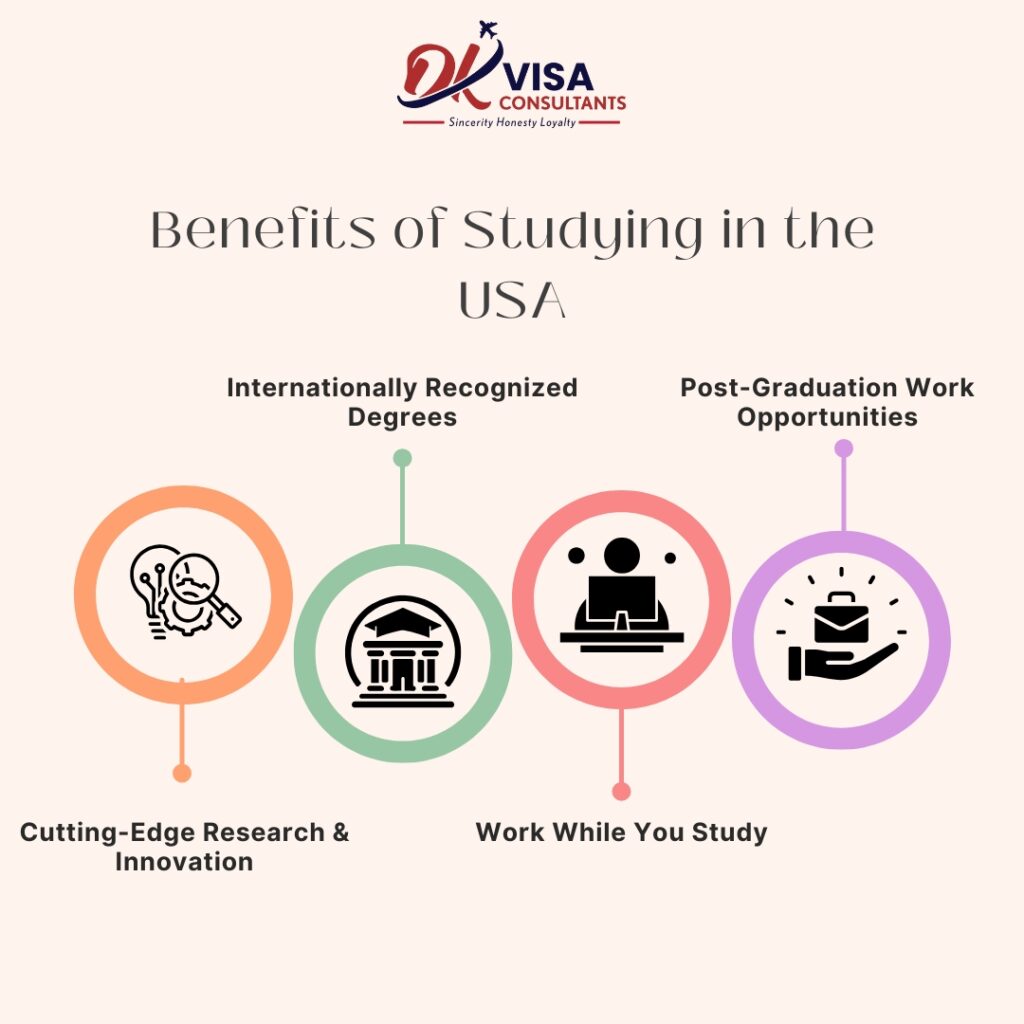
1. Cutting-Edge Research and Innovation

The USA leads the world in research and technological innovation, making it an ideal place for students interested in fields like engineering, artificial intelligence, medicine, and biotechnology. The country’s investment in higher education and research institutions means students have access to state-of-the-art labs, resources, and faculty experts.

2. Internationally Recognized Degrees

A degree from a US institution is recognized and highly respected globally. Whether you pursue undergraduate, graduate, or doctoral programs, employers worldwide value the quality of education and training you’ll receive. Graduating from a top US university can boost your career and open doors to international job markets.

3. Work While You Study

The F-1 visa allows international students to work part-time (up to 20 hours a week) during the semester and full-time during holidays. This is a great opportunity to gain work experience, network, and offset living expenses. Furthermore, students in fields like engineering, IT, and finance have even more chances to work off-campus through Curricular Practical Training (CPT) and Optional Practical Training (OPT).

4. Post-Graduation Work Opportunities

One of the major benefits of studying in the USA is the opportunity to extend your stay and gain practical work experience. The OPT program lets students work for up to 12 months (with a 24-month extension for STEM students). This experience can be a game-changer when applying for jobs, either in the US or internationally.

Eligibility and Admission Requirements

1. Academic Requirements

  • Undergraduate Courses: Applicants must have high school diploma or equivalent. Many universities also require standardized test scores like SAT or ACT.
  • Graduate Programs:  Must have bachelor’s degree from an accredited institution is required. Graduate schools may ask for standardized test scores like GRE, GMAT, or LSAT, depending on the program.

2. English Proficiency

Since courses in the US are taught in English, international students need to demonstrate proficiency in the language. Common tests include:

  • TOEFL (Test of English as a Foreign Language)
  • IELTS (International English Language Testing System)
  • PTE (Pearson Test of English)

Each university has its own minimum score requirements, so make sure to check specific guidelines.

3. Visa Requirements

To study in the USA International students must need an F-1 student visa. To obtain this visa, you must:

  • Have an I-20 form from your US university.
  • Must have  sufficient funds to cover tuition and living expenses.
  • Show your interest to return to home country after completing studies.

4. Application Process

The application process can vary from university to university, but generally includes:

  • Submitting transcripts and standardized test scores.
  • Writing a personal statement or essay.
  • Providing letters of recommendation.
  • Completing an interview (in some cases).

Best Universities to Study in the USA

The USA is home to a vast range of universities, but here are some of the top choices for international students:

Universities
Harvard University
Stanford University
Massachusetts Institute of Technology (MIT) 
University of California, Berkeley
Princeton University
  • Harvard University – Known for its prestige and academic rigor, Harvard is one of the most renowned universities globally, offering diverse programs in business, law, medicine, and the sciences.
  • Stanford University – Located in Silicon Valley, Stanford is a hub for innovation, technology, and entrepreneurship.
  • Massachusetts Institute of Technology (MIT) – A leader in engineering, technology, and STEM fields, MIT is perfect for those interested in cutting-edge research.
  • University of California, Berkeley – With its diverse range of programs, especially in social sciences, humanities, and engineering, UC Berkeley is a top choice for students
  • Princeton University – Known for its small class sizes and focus on undergraduate education, Princeton excels in liberal arts and sciences.

Best Courses to Study in the USA

The USA offers top-tier courses across a variety of fields. Some of the most popular and high-demand courses include:

  1. Business Administration – Programs in MBA and management at top schools like Harvard Business School and Wharton are renowned globally.
  2. Computer Science & IT – US universities like Stanford and MIT lead the world in AI, data science, and software engineering.
  3. Engineering – Whether it’s mechanical, civil, electrical, or aerospace engineering, the USA has some of the best engineering programs.
  4. Healthcare & Medicine – With leading institutions like Johns Hopkins and Harvard Medical School, the USA is a top choice for future doctors, nurses, and healthcare professionals.
  5. Law – US law schools like Yale, Harvard, and Columbia offer top-rated J.D. programs and specialize in various legal fields.

Job Opportunities in the USA for International Students

One of the most significant benefits of studying in the USA is the abundant job opportunities available to international students:

1. Part-Time Work During Studies

As an F-1 visa holder, you can work part-time (up to 20 hours/week) during the academic term and full-time during breaks. This helps applicants cover living expenses & earn work experience.

2. Curricular Practical Training (CPT)

During their academic program, CPT enables students to work in their subject of study. This gives students real-world experience and often enhances their resumes.

3. Optional Practical Training (OPT)

After graduation, international students can apply for OPT, which allows them to work in the USA for up to 12 months in their field of study (up to 36 months for STEM graduates). This work experience is invaluable for building a global career.

4. H-1B Visa

The H-1B visa allows international students to stay and work in the US for up to 6 years if they’re employed in a specialized occupation. Many students transition from OPT to the H-1B visa for long-term work in the USA.

Why Study in the USA is Better than Canada?

While Canada is also a popular destination for international students, the USA offers some distinct advantages:

  • Wider Range of Programs: The USA has a broader range of programs and specializations, giving you more options to pursue your academic and career goals.
  • Better Job Opportunities: The US job market, especially in sectors like technology, finance, and engineering, is larger and offers more opportunities for graduates.
  • Cultural Hub: The USA is a global leader in culture, providing students with access to a wider range of industries such as entertainment, media, and tech.

Conclusion

Studying in the USA is an investment in future, offering exceptional academic opportunities, job prospects, and global exposure. Whether you’re looking to study in one of the world’s top universities, explore cutting-edge fields, or embark on an exciting career, the USA has it all.

For more information, visit DK Visa Consultant. Meet our experts and indulge in end-to-end conversation about study in the USA.

FAQ

Q1. What Is the Cost of Studying in the USA?

Ans: The cost of studying in the USA varies depending on the university and the program. Estimated tuition fees range from $10,000 to $50,000 per year. Living expenses (housing, food, transportation) can add another $10,000 to $20,000 per year. However, there are numerous scholarships and financial aid options available to international students to help cover costs.

Q2. Can I Work While Studying in the USA?

Ans: Yes, as an F-1 visa holder, you can work part-time (up to 20 hours per week during the semester) on-campus. During breaks (like summer vacation), you can work full-time. Additionally, you may be eligible for Optional Practical Training (OPT) or Curricular Practical Training (CPT) to work in your field of study after completing your degree.

Q3. How Long Can I Stay in the USA After Graduation?

Ans: After completing your studies, you can stay in the USA for up to 12 months on OPT (Optional Practical Training). If you’re in a STEM field (Science, Technology, Engineering, and Mathematics), you can extend your OPT for an additional 24 months, giving you a total of 36 months of work experience in the USA.

Q4. What Is the Process for Getting a Job in the USA After Graduation?

Ans: After graduation, you can apply for an H-1B visa to work in the USA. The process involves securing a job with a US employer who will sponsor your visa application. Many international students transition from OPT to the H-1B visa, which allows you to work in the US for up to 6 years in specialized fields like IT, engineering, healthcare, and finance.

Q5. What Should I Know About Accommodation in the USA?

Ans: Most universities offer on-campus housing, which can be convenient but may fill up quickly. If you prefer more independence or cannot secure on-campus accommodation, you can look for off-campus housing. Rent prices vary by city, so make sure to budget for housing before you arrive.

Q6. Is Studying in the USA Worth the Investment?

Ans: Yes, studying in the USA is a significant investment, but it can pay off in terms of high-quality education, career opportunities, and personal growth. Graduating from a top US university opens doors to global career prospects, higher earning potential, and valuable professional networks. The work opportunities available through OPT and H-1B visas further increase the return on your investment.


Why Study in New Zealand?

New Zealand has quickly emerged as one of the most popular destinations for international students, offering a unique combination of world-class education, a friendly environment, stunning landscapes, and excellent career opportunities. Whether applicants are looking to study in a city surrounded by nature, pursue a specific field of study, or build a global career, New Zealand has something for everyone.

Below are the reasons:

Why choose New Zealand?

1. World-Class Education System

New Zealand is renowned for its high-quality education system, with universities consistently ranked among the top institutions globally. The country offers a balanced approach to learning, combining theoretical knowledge with practical skills that prepare students for the challenges of the real world. New Zealand’s education system promotes critical thinking, innovation, and problem-solving, making it an ideal environment for students who want to gain in-depth knowledge and practical experience in their chosen field.

2. Safe, Friendly, and Welcoming Environment

Safety and a sense of belonging are essential for international students, and New Zealand excels in these areas. The country boasts a low crime rate and is often ranked as one of the safest places in the world. The Kiwi culture is known for its friendliness, makes international students to settle in and feel at home. With a multicultural society and supportive communities, New Zealand provides a comfortable environment for students from all over the world.

3. Affordable Tuition Fees and Living Costs

Compared to other popular study destinations like the USA, UK, or Australia, New Zealand offers relatively affordable tuition fees and living costs.

DegreesEstimated Tuition Fees (yearly)
UndergraduateNZD 22,000 – 32,000
Postgraduate26,000 – 37,000 NZD

Living costs are also lower compared to other countries, and students can take advantage of part-time work to support their expenses.

4. Post-Study Work Opportunities

One of the major advantages of studying in New Zealand is the ability to work after graduation. The Post-Study Work Visa allows international students to stay and work in New Zealand for 1 to 3 years depending on the level of qualification they have completed. This provides the perfect opportunity to gain valuable local work experience, build a professional network, and enhance career prospects. Moreover, New Zealand offers pathways to residency, which is a significant advantage for students who wish to settle in the country permanently.

5. Stunning Natural Beauty and Outdoor Activities

New Zealand is famous for its breathtaking landscapes, ranging from lush rainforests and snow-capped mountains to sparkling lakes and golden beaches. For students who love adventure and outdoor activities, New Zealand is the perfect destination. Whether you’re into hiking, skiing, surfing, or exploring natural wonders, there’s no shortage of things to do outside of your studies. The natural beauty of the country also provides a relaxing environment that helps students maintain a healthy balance between work and leisure.

Best Universities to Study in  New Zealand

New Zealand boasts several top-ranking universities that offer a wide range of courses across various fields of study. Here are some of the best universities:

Universities
University of Auckland
Victoria University of Wellington
University of Otago
Auckland University of Technology (AUT)
University of Canterbury

1. University of Auckland

The University of Auckland is New Zealand’s highest-ranked university, known for its research excellence and high-quality programs in business, law, medicine, engineering, and more. It’s one of the best choices for international students looking to pursue both undergraduate and postgraduate studies.

2. University of Otago

The University of Otago is one of New Zealand’s oldest universities, offering world-class programs in health sciences, medicine, law, and business. Located in the charming city of Dunedin, it provides a rich academic experience combined with a vibrant student community.

3. Victoria University of Wellington

Situated in the capital city, Victoria University of Wellington is well-regarded for its programs in law, arts, humanities, creative arts, and political science. The university offers an inspiring academic environment with close connections to New Zealand’s political and cultural landscape.

4. University of Canterbury

The University of Canterbury is famous for its strong programs in engineering, computer science, and environmental studies. The university is located in Christchurch, a city that has become a hub for innovation and research after the 2011 earthquake, making it a great place for students pursuing STEM fields.

5. Auckland University of Technology (AUT)

AUT is a modern and industry-focused university, well-known for its programs in business, design, communication, and health sciences. The university places strong emphasis on practical skills and industry connections, preparing students for successful careers in their chosen fields.

Popular Courses to Study in New Zealand

New Zealand offers various courses that cater to several interests and career goals. Here are some of the courses:

Popular Courses to Study in New Zealand

1. Business and Management

New Zealand has a strong reputation for its business and management programs. Universities like University of Auckland and Victoria University of Wellington offer excellent degrees in business administration, finance, marketing, accounting, and international business. With a focus on practical skills and global business practices, these programs help students build a solid foundation for successful careers.

2. Engineering and Technology

For students interested in STEM fields, New Zealand is home to some of the best engineering and technology programs. The University of Canterbury and University of Auckland are known for their cutting-edge programs in civil, mechanical, electrical, and software engineering. Graduates of these programs often find high-demand job opportunities both in New Zealand and internationally.

3. Healthcare and Medical Sciences

New Zealand’s medical and healthcare programs are highly regarded, especially those at University of Otago, Auckland University of Technology (AUT), and University of Auckland. Students can pursue degrees in medicine, nursing, pharmacy, dentistry, and public health. New Zealand offers great job prospects for healthcare professionals, making it an attractive destination for students in this field.

4. Creative Arts and Design

For students passionate about the creative industries, New Zealand offers outstanding programs in graphic design, fashion design, film production, and performing arts. Victoria University of Wellington and AUT offer specialized courses that provide students with the skills they need to thrive in the global creative sector.

5. Hospitality and Tourism Management

New Zealand has a booming tourism industry, and it is an excellent place to study hospitality and tourism management. The Auckland University of Technology (AUT) and other institutions offer programs that combine management theory with practical training, preparing students for a successful career in one of the world’s largest industries.

Eligibility Criteria and Admission Requirements

The eligibility criteria for studying in New Zealand vary by university and program. However, there are some general requirements:

1. Academic Qualifications

  • For undergraduate courses: Applicants will need to complete high school education or an equivalent qualification.
  • For postgraduate courses: A relevant undergraduate degree or its equivalent is required.

2. English Language Proficiency

International students must demonstrate proficiency in English. Accepted tests include IELTS, TOEFL, or PTE. The minimum required score varies by institution and program.

3. Proof of Funds

Students need to show that they have sufficient funds to cover tuition fees and living expenses for the duration of their studies.

4. Offer of Admission

Applicant must have a confirmed offer of admission from a recognized New Zealand institution to apply for a student visa.

5. Student Visa

After meeting the academic and English requirements, students need to apply for a student visa, which allows them to stay in New Zealand for the duration of their course.

Job Opportunities for International Students in New Zealand

New Zealand provides a range of job opportunities for international students, both during and after their studies:

  • Part-Time Work During Studies

International students are allowed to work up to 20 hours per week during the academic year and full-time during university holidays. Many students take up jobs in hospitality, retail, or administration to gain work experience and support living expenses.

  • Post-Study Work Visa

After graduation, international students can apply for a Post-Study Work Visa to stay and work in New Zealand. Depending on the qualification and location of study, the visa can be valid for up to three years. This allows graduates to gain valuable work experience, and in many cases, it leads to full-time employment and permanent residency.

  • Graduate Employment Opportunities

New Zealand’s growing economy and vibrant industries mean that there are plenty of job opportunities for graduates. Fields like engineering, healthcare, business, and technology are particularly in demand.

Why Do International Students Choose New Zealand Over Other Countries?

1. Quality of Education

Universities in New Zealand are globally recognized, with an emphasis on practical learning and critical thinking. The high-quality education system and affordable tuition fees make it an attractive option for students.

2. Work Opportunities

New Zealand offers great post-study work opportunities, including a Post-Study Work Visa, which allows students to stay and work for up to three years. This is a significant advantage compared to countries like the USA and UK, where work visas can be more restrictive.

3. Pathway to Residency

It offers a relatively simple pathway to permanent residency for international students who complete their qualifications and meet certain criteria. This is especially appealing compared to other countries where securing a work visa or residency can be more competitive or challenging.

4. Safe and Welcoming Environment

With its low crime rates, clean air, and friendly locals, New Zealand offers a safe and supportive environment for international students, making it one of the top destinations for students seeking peace of mind while studying abroad.

Conclusion

Study in New Zealand offers many advantages—from high-quality education to incredible work opportunities and a beautiful, safe environment. Whether you’re interested in pursuing a degree in business, engineering, healthcare, or the arts, New Zealand provides world-class programs to help you achieve your academic and career goals.

At DK Visa Consultant, we assist students throughout the entire process—from selecting the right program to securing your student visa.

FAQ

Q1. How do I apply to a university in New Zealand?

Ans: The application process typically involves:

  • Choosing the program you want to study.
  • Checking the admission requirements for your chosen university.
  • Submitting your application online, including required documents like academic transcripts, proof of English proficiency, and a statement of purpose.
  • Once accepted, you will receive an Offer from the university, which is required to apply for a student visa.

Q2. What are the tuition fees in New Zealand?

Ans: The tuition fees for international students vary depending on the program and university. On average:

  • Undergraduate courses: NZD 22,000 to NZD 32,000 per year.
  • Postgraduate courses: NZD 26,000 to NZD 37,000 per year.
  • Living expenses range between NZD 15,000 to NZD 20,000 annually, depending on your lifestyle and location.

Q3. What is the English language requirement for studying in New Zealand?

Ans: Most universities require proof of English language proficiency, typically through IELTS, TOEFL, or PTE. A minimum IELTS score of 6.0 to 6.5 (depending on the program) is usually required, but some universities may accept other tests as well. It’s important to check specific university requirements for your chosen program.

Q4. What are the best cities to live and study in New Zealand?

Ans: Some of the most popular cities for international students include:

  • Auckland: New Zealand’s largest city, home to top universities and a vibrant multicultural environment.
  • Wellington: The capital city, known for its creative arts and political culture.
  • Christchurch: A hub for engineering, science, and technology students.
  • Dunedin: A student-friendly city with a rich academic history and the University of Otago.

Each city has its own unique character and lifestyle, so your choice depends on your preferences and field of study.

Q5. Why should I choose New Zealand over other study destinations like Australia, UK, or USA?

Ans: New Zealand stands out for its affordable tuition fees, high quality of life, and strong work opportunities after graduation. The relatively easy pathway to permanent residency compared to countries like the USA or UK makes it a very attractive option. New Zealand also offers a more personalized and student-focused experience, with smaller class sizes and a strong emphasis on practical learning.

Why to Study in Australia? 

Australia has been a favourite destination for international students, offering a unique combination of high-quality education, diverse cultural experiences, and numerous opportunities for personal and professional growth. As a leading global study destination, Australia consistently ranks among the top countries for higher education, attracting students from all over the world.

If students considering studying abroad, here’s why they should choose  Australia. Read the blog to know more. 

Why choose Australia?

Below are the reason to choose Australia for study:
 
1. World-Class Education System
 
Australia is home to some of the world’s best universities, many of which rank among the top 100 globally. The nations education system is globally recognized for its high academic standards, teaching methods, and research excellence.

The Australian Qualifications Framework (AQF) ensures that all degrees, diplomas, and certificates offered by institutions are of world-class quality, meeting the needs of a global job market.
 

2. Diverse and Inclusive Culture
 
Australia’s multicultural society makes it a welcoming environment for students from all over the world. With over 25% of its population born overseas. Australia provides an opportunity for students to meet new people, learn about different cultures, and broaden their horizons.

The country’s vibrant cities such as Sydney, Melbourne, and Brisbane offer a rich mix of art, culture, cuisine, and recreational activities. Ensuring that students can make the most of their time both inside and outside the classroom.
 
3. High Quality of Life
 
Australia is known for its high living standard. The country’s excellent healthcare system, public safety, and clean environment contribute to its reputation as one of the most liveable places in the world. Major cities in Australia, including Sydney, Melbourne, and Adelaide, regularly feature in global rankings for quality of life, making it an attractive destination for students seeking a balance between academics and a healthy lifestyle.
 
4. Post-Graduation Work Opportunities
 
Australia offers many opportunities for international students to earn work experience after completing their studies. The Australian Government’s post-study work visa program allows international graduates to stay and work in the country for a period of 2 to 4 years, depending on the qualification level. This gives students the opportunity to apply their skills in a real-world setting, build their professional network, and potentially transition into permanent residency.


Best Universities to Study in Australia

The nation has some of the world’s top-notch universities. These institutions are renowned for their academic excellence, state-of-the-art facilities, and research output. Some of the top universities in Australia are:
  

Universities
The University of Melbourne
Australian National University (ANU)
University of Sydney
The University of Queensland
University of New South Wales

1.University of Melbourne:
The University of Melbourne is one of the top universities globally, offering a wide range of programs at both undergraduate and postgraduate levels. It is known for its research excellence, in specific fields like health, engineering, and business.
 
2. Australian National University (ANU):
ANU is consistently ranked among the top universities in the world, located in Canberra. It is known for its high academic standards, particularly in the fields of politics, international relations, and environmental science.
 
3. University of Sydney
The University of Sydney is one of the oldest and most renowned universities in Australia. It offers a wide range of programs and is well known for its research contributions, particularly in the areas of health sciences, engineering, and social sciences.
 
4. University of Queensland (UQ):
Located in Brisbane, UQ is known for its strong research output and excellent facilities. UQ ranks highly in a variety of disciplines, including life sciences, business, and engineering.
 
5.University of New South Wales (UNSW):
UNSW in Sydney is one of Australia’s leading research institutions. It offers a broad array of programs and is highly regarded in fields such as engineering, computer science, and business.


 Eligibility Requirements for Study in Australia

To study in Australia, international students need to meet specific eligibility criteria. While these can vary depending on the level of study and the institution, the general requirements include:
 
1.Academic Qualifications:

  • Undergraduate Programs:

Candidates typically need to have completed secondary school (high school) with good academic results. Requirements may depends on the course and university applicant desire to enrol.

  • Postgraduate Programs:

A recognized undergraduate degree from an accredited institution is required. Some courses may require experience in a relevant field(if necessary).

2. English Proficiency:

International applicants must possess English proficiency in the language. This can be done by submitting scores from English language tests such as IELTS, TOEFL, or PTE.

  • IELTS: A minimum score 6.0-7.0, depending on the courses applicant desires.
  • TOEFL: A minimum score of 70-100.
  • PTE : A minimum score of 50-65.

3. Visa Requirements:

International students must apply for a (subclass 500) student visa. This visa allows students to stay in Australia for the duration of their course, with the possibility of extending it under certain conditions. The student visa application requires proof of enrolment in an Australian educational institution, financial capability to support living expenses, and health insurance.
 

Admission Process for Study in Australia:

The admission process for studying in Australia typically involves the following steps:

Admission Process for study in Australia


1. Research and Choose Your Program
Start by researching the courses and universities that match your interests and career goals. Visit university websites to understand their program offerings, entry requirements, and deadlines.
 
2. Prepare Your Documents
Common documents needed for admission include:

  • Academic transcripts and certificates
  • English language proficiency test scores
  • Statement of Purpose (SOP)
  • Letters of Recommendation (LOR)
  • CV/Resume (for postgraduate programs)
  • Passport copy


3. Apply to Universities
Once you’ve selected your program, submit your application to the chosen universities. Some universities may require you to apply directly through their website, while others might use application portals like UAC or VTAC.
 
4. Wait for an Offer
After submitting your application, universities will review your documents and send an offer letter if you meet their eligibility criteria. Candidates may receive a conditional or unconditional offer based on their academic qualifications.
 
5. Accept Offer & Apply for a Visa
After accepting an offer, apply for a student visa. Ensure that you meet the visa requirements and submit all necessary documents, including proof of enrollment, financial documents, and health insurance.
 
6. Prepare for Departure
Before leaving for Australia, make sure to arrange accommodation, flight tickets, and travel insurance. It’s also important to familiarise yourself with Australian culture, customs, and any travel restrictions.


 Job Prospects After Studying in Australia

Australia’s robust economy and high demand for skilled workers make it an attractive destination for graduates seeking job opportunities. The country has a strong job market, with particular demand in sectors such as healthcare, engineering, information technology, and education.
 
1. Post-Study Work Visa
Australia’s Temporary Graduate Visa (subclass 485) allows international students who have completed at least two years of study in Australia to stay and work for up to 4 years. This provides an excellent opportunity to gain valuable work experience, which can increase your chances of securing a permanent job in Australia.
 
2. Skilled Migration
If applicant studied in an occupation that is in demand in Australia, they may be eligible for permanent residency through the skilled migration program. The country’s point-based system assesses applicants based on factors like age, education, work experience, and language proficiency.
 
3. Career Support from Universities
Most Australian universities offer career services, including internships, job placement assistance, and networking opportunities with industry professionals. These resources can significantly improve your chances of finding employment after graduation.


 Why Australia is better than other countries?

When considering studying abroad, many students naturally look at a few popular study destinations: Canada, the UK, the USA, and Australia. Each of these countries offers world-class educational opportunities, but Australia stands out for several reasons—both during your studies and post-graduation. 
 
Here’s a detailed comparison that helps explain why Australia is a better choice than Canada, the UK, and the USA:
 
1. Education Quality and Flexibility

  • Australia vs. Canada

While both Australia and Canada are home to high-quality universities, Australia is often preferred due to its global ranking of universities and flexible study options. Institutions like the University of Melbourne, ANU, and the University of Sydney are renowned for their research excellence and teaching methods, often outperforming Canadian institutions in international rankings.

Australia also offers a wider variety of specialized courses, especially in the fields of engineering, IT, and business management, that are tailored to global industry standards.

  • Australia vs. the UK

Australia’s universities are often ranked higher in global rankings, particularly in research-driven subjects like healthcare, engineering, and business. Furthermore, Australia’s academic year structure is more student-friendly, typically offering intake periods in February and July, whereas UK universities have a fixed academic calendar that may not align with many international students’ schedules. Australia also offers a more diverse range of scholarships for international students compared to the UK, making it more affordable.

  • Australia vs the USA

While the USA is home to some of the world’s most prestigious universities, the high cost of education and a more complex visa and immigration system make it less attractive for many international students. Additionally, Australia’s affordable tuition fees, particularly for undergraduate degrees, are significantly lower than those of many US institutions. Moreover, the cost of living in Australia is often less than in cities like New York, Boston, or San Francisco, which makes it easier for students to manage their finances.
 
2. Post-Graduation Work Opportunitie
s

  • Australia vs. Canada

Both Australia and Canada offer post-study work opportunities, but Australia’s system is arguably more flexible and beneficial. While Canada provides a Post-Graduation Work Permit (PGWP), which allows graduates to work for up to 3 years, Australia’s Temporary Graduate Visa (subclass 485) allows international graduates to stay and work for 2 to 4 years depending on the level of qualification. Importantly, Australia offers work rights to students during their studies, allowing them to work up to 40 hours per fortnight during the semester, and unlimited hours during holidays, which can help offset living costs.
 
Additionally, Australia’s Graduate Work Visa is tied to fields that are in demand in the country, making it easier for students to transition into full-time employment. This is more streamlined than Canada’s approach, where work permits are not always guaranteed after the completion of your studies.
 

  • Australia vs. the UK

Post-study work options in the UK are quite limited unless you qualify for specific programs like the Graduate Visa, which allows you to stay for 2 years. In contrast, Australia’s post-study work visa (subclass 485) is more comprehensive and has a wider range of options. Additionally, Australia’s regional work opportunities provide a pathway to permanent residency, which is often more accessible than in the UK.

  • Australia vs. the USA

In the USA, while students can work on F-1 visas, the pathway to work in the USA after study can be complex, requiring sponsorship through H-1B visas, which are highly competitive. The post-graduation work visa options in the USA are not as clearly defined as Australia’s system, and the limited duration of stay (often just one year for non-STEM fields) makes it difficult for international students to establish long-term careers. In contrast, Australia offers an easier pathway to full-time work through the Temporary Graduate Visa and provides more clarity and ease when it comes to transitioning into permanent residency.
 
3. Pathway to Permanent Residency (PR)

  • Australia vs. Canada

Canada is known for its open immigration policies, and many international students do indeed choose Canada for its relatively straightforward pathway to permanent residency. However, Australia’s skilled migration program is more directly linked to your qualifications, experience, and job sector. Australia’s points-based immigration system (Skilled Independent Visa subclass 189) gives international graduates an easier pathway to PR based on your degree and work experience, especially if your qualifications are in high-demand areas such as IT, engineering, or healthcare.
 
While Canada also has a points system (Express Entry), it can be more competitive, and the application process is longer. In contrast, Australia offers more direct pathways from student visas to permanent residency, particularly through the Regional Sponsored Migration Scheme (RSMS), which encourages graduates to live and work in regional areas.

  • Australia vs. the UK

The UK’s route to PR can be more difficult for international students. While the Graduate Visa allows students to work for 2 years after graduation, it does not automatically lead to PR. You’ll need to transition to a skilled worker visa, which has stringent requirements, including sponsorship from an employer. Australia, on the other hand, offers an easier transition through the Employer Nomination Scheme (ENS) or Skilled Regional Visas, and many students find that their qualifications from Australian universities provide an automatic advantage in the migration process.

  • Australia vs. the USA

The USA’s immigration system is highly complex, and the road to permanent residency is much more uncertain, particularly for international students. In contrast, Australia’s skilled migration program offers clearer pathways for graduates who want to stay and work in the country long-term. If your occupation is on the Skilled Occupation List, your chances of obtaining permanent residency after graduation are significantly higher.
 
Australia’s General Skilled Migration (GSM) program, which selects immigrants based on a points system, often prioritizes applicants with Australian degrees and work experience, making it easier for international graduates to become permanent residents. Unlike the USA, where visa caps and lottery systems can complicate the process, Australia’s migration system is more predictable and transparent.
 
4. Affordability and Cost of Living

  • Australia vs. Canada

While both countries have a similar cost of living, Australia’s cities tend to be slightly more affordable than major Canadian cities like Vancouver or Toronto. Housing and general expenses in cities like Sydney and Melbourne are comparable to Canadian counterparts but often come with better student discounts and support systems for international students.

Australia’s healthcare system, Medicare, is also more affordable for eligible students compared to Canada’s healthcare costs, which can be more expensive for international students without provincial health insurance.

  • Australia vs. the UK

The cost of living in the UK is generally higher than in Australia, particularly in cities like London, where rent and everyday expenses can be quite steep. Australia’s cities, such as Melbourne and Brisbane, offer a more affordable lifestyle while maintaining the high quality of life and world-class amenities you would expect from major global cities.

  • Australia vs. the USA

The cost of living in the USA, especially in cities like New York, Los Angeles, and San Francisco, can be prohibitively expensive, especially for students. In comparison, Australia offers lower tuition fees for international students and more affordable living expenses, making it a more cost-effective option overall.


Conclusion

Australia offers a fantastic opportunity for international students seeking a quality education, a multicultural environment, and promising career prospects. With its world-class universities, high standard of living, and post-graduation work opportunities, studying in Australia is an investment in your future. Whether you want to explore new academic fields, gain practical work experience, or immerse yourself in an exciting culture, Australia has it all.
 
At DK Visa Consultant, we provide expert guidance throughout the entire process of applying to study in Australia, from selecting the right course to securing your student visa. Reach out to us today to begin your journey toward an unforgettable educational experience in Australia.
 

FAQ

Q1. What are the requirements to study in Australia?

Ans: To study in Australia, you generally need:

  • Academic qualifications: A completed secondary school certificate for undergraduate courses or a recognized bachelor’s degree for postgraduate studies.
  • English proficiency: Proof of your English language skills (e.g., IELTS, TOEFL, or PTE scores).
  • Health & character requirements: Medical check-ups and a police clearance certificate might be required.
  • Student Visa: A valid Australian student visa (subclass 500) is necessary.

Q2. What is the cost of studying in Australia?

Ans: The cost of studying in Australia varies depending on the course and university, but here’s a general breakdown:

  • Undergraduate degrees: Typically between AUD $15,000 to AUD $33,000 per year.
  • Postgraduate degrees: Generally range from AUD $20,000 to AUD $50,000 per year.
  • Living costs: Around AUD $20,000 to AUD $27,000 annually, depending on the city (Sydney and Melbourne tend to be more expensive).

Q3. Can I work while studying in Australia?

Ans: Yes, international students can work in Australia on a student visa. You’re allowed to work up to 40 hours per fortnight during the semester and full-time during holidays. Working part-time can help cover some living expenses.

Q4. What is the student visa processing time?

Ans: The processing time for an Australian student visa typically ranges from 4 to 12 weeks, depending on the application type, completeness of documents, and your country of residence. It’s recommended to apply at least 3 months before your course begins to ensure enough processing time.

Q5. How do I get accommodation in Australia?

Ans: Students can choose from several accommodation options:

  • Hostels: Short-term affordable accommodation while searching for something permanent.
  • University-managed accommodation (on-campus or nearby).
  • Private rentals: Houses or apartments shared with other students.
  • Homestay: Living with a local family for cultural immersion.