How to Choose the Right Country for Higher Education Abroad

Choosing the right country for higher education abroad is one of the most important decisions for international students planning to pursue global academic and career opportunities. In 2025, students are increasingly seeking destinations that offer world-class education, affordable tuition, career prospects, and cultural inclusiveness. Countries like Canada, Australia, the United Kingdom, the United States, Germany, and New Zealand remain top choices due to their strong education systems and post-study work options.

This comprehensive guide explores how to evaluate and select the right country for higher education abroad based on academic goals, visa policies, cost of living, employment opportunities, and long-term immigration pathways.

Factors to Consider While Choosing a Country for Higher Education Abroad

1.Quality of Education

  • Check global university rankings and accreditations.
  • Evaluate the course curriculum and academic faculty.
  • Consider practical learning, research facilities, and industry connections.

2. Post-Study Work Opportunities

  • Evaluate the country’s skill shortage list and job market demand.
  • Understand the duration and conditions of post-study work visas.
  • Review industries hiring international graduates.

3. Immigration and PR Pathways

  • Understand how education contributes to long-term settlement.
  • Explore visa-to-permanent residency options.
  • Check if the country offers points-based immigration systems.

4. Cost of Education and Living

  • Look for scholarships, bursaries, and part-time work options.
  • Compare tuition fees across countries and institutions.
  • Consider living expenses, accommodation, and health insurance.

5. Language and Entry Requirements

  • Review academic eligibility, gap acceptance, and admission process.
  • Check language of instruction and English proficiency requirements.
  • Explore language support or foundation courses if needed.

6. Cultural Diversity and Safety

  • Understand local laws, safety index, and international student welfare.
  • Research the inclusiveness and student support policies.
  • Evaluate cultural adaptability and social environment.

7. Visa Success Rate and Processing Time

  • Review typical application timelines and embassy appointments.
  • Analyze acceptance trends and average visa approval rates.
  • Understand documentation requirements and interview policies.

Top Study Abroad Destinations in 2025: Country Comparison

CountryTop CoursesTuition Fees (Annual)Post-Study WorkPR PathwaysLanguage
CanadaIT, Business, HealthcareCAD 15,000 – 30,000Up to 3 yearsYes (Express Entry)English
AustraliaNursing, Engineering, MBAAUD 18,000 – 40,000Up to 4 yearsYes (Points System)English
USASTEM, Business, ArtsUSD 20,000 – 50,0001 to 3 years (OPT)Limited (H1B route)English
UKData Science, Law, ManagementGBP 10,000 – 25,0002 yearsYes (Graduate Route)English
GermanyEngineering, IT, DesignMostly Free – €5,00018 monthsYes (Job Seeker Visa)German/English
New ZealandTourism, IT, NursingNZD 15,000 – 30,000Up to 3 yearsYes (Skill-based)English
IrelandComputer Science, Pharma, FinanceEUR 10,000 – 25,0001 to 2 yearsYes (Critical Skills)English

Popular Countries and Their Unique Advantages

Choosing the right study destination depends on various individual goals—whether they relate to employment, academic excellence, affordability, or long-term settlement. Each popular study abroad country in 2025 offers distinct benefits tailored to specific academic and career aspirations.

Below is a detailed breakdown of what makes each destination uniquely attractive to international students.

1. Canada 

Country consistently ranks among the top study destinations for international students, thanks to its world-renowned academic institutions, high-quality education system, and inclusive multicultural environment. With numerous top-ranking universities and colleges offering a wide range of diploma, undergraduate, and postgraduate programs, students benefit from both theoretical and practical learning experiences. Canada’s education system emphasizes research, innovation, and skill-based development, making its graduates highly competitive in the global job market.

The country also offers robust post-study work opportunities. International graduates can obtain a Post-Graduation Work Permit (PGWP) valid for up to three years, depending on the length of their program. This work experience can be a key asset in applying for permanent residency through Canada’s Express Entry or Provincial Nominee Program (PNP). The immigration process is transparent, points-based, and student-friendly, with many pathways directly linked to Canadian education credentials. Moreover, Canada’s commitment to student welfare, healthcare access, and public safety makes it an ideal long-term option for those planning to study, work, and settle abroad.

2. Australia

The nation is home to several prestigious universities ranked among the top 100 globally, including the University of Melbourne, University of Sydney, and Australian National University. The country offers a broad spectrum of programs across disciplines such as nursing, business, engineering, IT, and environmental science. One of the major advantages is its post-study work rights, which extend up to 4 years depending on the level and location of study. This work experience can significantly contribute to permanent residency applications through Australia’s General Skilled Migration (GSM) program, which uses a transparent points-based system.

The Tuition Protection Service (TPS) ensures that international students’ tuition fees are safeguarded, providing a secure study environment. Additionally, Australia provides excellent part-time work opportunities during studies (up to 48 hours per fortnight), allowing students to gain work experience and support themselves financially. Major cities like Sydney, Melbourne, Brisbane, and Perth are multicultural hubs offering strong student support networks, quality of life, and vibrant campus experiences. Australia is also known for its focus on employability, practical learning, and a growing demand for skilled professionals in fields such as healthcare, education, and technology.

3. United Kingdom

The United Kingdom is a leading global education hub, home to some of the most prestigious institutions in the world, such as the University of Oxford, University of Cambridge, Imperial College London, and London School of Economics (LSE). These universities consistently rank high in global education indexes due to their academic excellence, cutting-edge research facilities, and strong employer reputation.

The UK government supports international students through policies like the Graduate Route, which allows graduates to stay and work in the country for up to 2 years (3 years for PhD holders) after completing their degree. This post-study work visa gives students the opportunity to gain professional experience, build global networks, and explore long-term job prospects. Fields such as data science, engineering, finance, healthcare, and AI offer high demand for skilled graduates.

The UK also offers several scholarships and financial aid programs, including the Chevening Scholarships, Commonwealth Scholarships, GREAT Scholarships, and university-specific bursaries aimed at reducing financial barriers for deserving international students. Furthermore, the country’s cultural diversity, strong public transportation system, and world-class healthcare (NHS access) create a comfortable living environment.

With a robust education system, globally recognized degrees, and supportive post-study policies, the UK is a right country for higher education abroad for students aiming to gain a world-class education with international career potential.

4. United States 

It is home to the largest number of top-ranked universities in the world, including institutions like Harvard, MIT, Stanford, and UC Berkeley. It offers unmatched diversity in academic programs, research opportunities, and campus life. International students can participate in Optional Practical Training (OPT), which allows them to work in the U.S. for up to 12 months after graduation, and up to 36 months for STEM graduates.

Although permanent residency pathways such as the H-1B visa and Green Card are competitive and limited, many students successfully transition into long-term employment or higher education. The U.S. is also a hub for innovation and entrepreneurship, with access to leading companies in technology, finance, healthcare, and media. Its vast academic infrastructure and global alumni networks provide long-term career advantages and global mobility for graduates.

5. Germany 

The nation emerged as a top destination for international students, especially those pursuing engineering, IT, and technical programs. Public universities in Germany offer tuition-free education or minimal fees for both domestic and international students, significantly reducing the cost of higher education. Many programs, especially at the postgraduate level, are offered in English, making it accessible to non-German speakers.

Germany also offers an 18-month post-study work visa, allowing graduates to stay and seek employment related to their field of study. Those who find a job within this period can transition to a residence permit for employment and eventually apply for permanent residency. The country’s strong economy, innovation-driven industries, and high demand for skilled professionals make it an excellent option for students aiming for affordable education with long-term career growth.

6. New Zealand 

It combines academic excellence with a high quality of life, making it a compelling choice for international students. The country is known for its focus on practical learning, student support, and career readiness. Popular programs include information technology, hospitality, agriculture, nursing, and environmental sciences. International graduates are eligible for a post-study work visa of up to three years, depending on their qualification level and location of study.

New Zealand’s immigration policies are welcoming, with a clear pathway to skilled migration and permanent residency. The country also allows international students to work part-time during studies and full-time during holidays. With a peaceful environment, modern infrastructure, and strong safety standards, New Zealand offers a nurturing space for academic and personal development.

7. Ireland

The nation is gaining popularity among international students, especially in the fields of computer science, pharmaceuticals, and finance. The country hosts several globally recognized universities and institutes of technology, offering industry-aligned programs and research opportunities. Students are allowed to stay for up to two years after graduation to seek employment under the Third Level Graduate Scheme.

The economy is driven by multinational corporations, especially in the tech and pharma sectors, with companies like Google, Facebook, Pfizer, and Intel operating major hubs. The Critical Skills Employment Permit makes it easier for graduates in high-demand occupations to secure jobs and eventually apply for permanent residency. English-speaking environment, vibrant cultural heritage, and proximity to mainland Europe further add to Ireland’s appeal as a study destination.

How to Make the Final Decision to Choose the Right Country for Higher Education Abroad ?

Making a final decision to choose the right country for higher education abroad involves a combination of research, financial planning, and strategic goal-setting. By understanding personal objectives and mapping them against country-specific advantages, international students can confidently select the most suitable study abroad destination.

  1. Identify Educational Priorities and Goals
  • Clarify the purpose of studying abroad: academic development, career growth, research, or immigration.
  • Determine whether the focus is on theoretical knowledge, practical skills, or a combination of both.
  • Choose programs that align with long-term professional aspirations.

2. Analyze Return on Investment (ROI)

  • Compare expected salary packages, job placement rates, and employment networks of each country.
  • Consider how quickly the investment in education can be recovered through post-study employment.
  • Factor in the country’s taxation policies, cost of living, and currency conversion impact.

3. Understand Country-Specific Policies

  • Look into family reunification options if planning to settle long-term.
  • Stay updated with immigration changes, work permit updates, and stay-back policies.
  • Understand each country’s approach to international students during uncertain global events (e.g., pandemics, geopolitical shifts).

4. Rank Shortlisted Options

  • Narrow down to 2–3 countries that meet academic, financial, and immigration needs.
  • Create a comparison chart listing tuition, work rights, PR possibilities, living conditions, and support services.
  • Use a scoring system to objectively rank each destination based on personal priorities.

5. Seek Professional Guidance and Testimonials

  • Ensure that consultants provide transparent information and avoid making unrealistic promises.
  • Connect with verified alumni and students via forums, webinars, and student networks.
  • Consult study abroad experts for personalized advice, eligibility assessments, and university shortlisting.

6. Plan the Timeline and Application Strategy

  • Apply to multiple institutions across different countries to keep options open while ensuring a backup strategy.
  • Research deadlines for university intakes, entrance exams, scholarships, and visa processing.
  • Develop a clear plan from application to arrival, including document preparation and financial planning.

Conclusion 

Selecting the right country for higher education abroad in 2025 depends on a clear understanding of academic goals, affordability, immigration preferences, and lifestyle compatibility. Each country offers unique benefits, so making an informed decision is key to long-term success. An expert study abroad consultant like DK Visa Consultant can assist with career mapping, course selection, application support, and visa filing for a hassle-free journey.

For detailed guidance and application assistance, connect with DK Visa Consultant today.

FAQ

Q1. Which country offers the easiest PR after study? 

Ans: Canada and Australia are considered the best for PR due to their transparent and points-based immigration systems.

Q2. Which country is most affordable for international students? 

Ans: Germany and some European nations offer low to no tuition fees for international students.

Q3. Which countries accept study gap and backlogs? 

Ans: Countries like Australia, Canada, and New Zealand accept gaps if supported with valid documentation.

Q4. Can international students work while studying abroad? 

Ans: Yes, most countries allow part-time work (15–20 hours/week) during study and full-time during vacations.

Q5. Which English proficiency tests are accepted globally? 

Ans: IELTS, TOEFL, PTE Academic, and Duolingo English Test are commonly accepted across most study destinations.

Top In-Demand Jobs in Dubai for Skilled Professionals

Searching for in-demand jobs in Dubai, understanding the Dubai skilled visa process, and identifying the best sectors for work in Dubai has become a priority for many aspiring professionals. Dubai continues to be one of the most preferred global destinations for skilled professionals, especially from India, Pakistan, Bangladesh, the Philippines, and other Asian countries. With its tax-free income, modern infrastructure, safe environment, and rapidly growing sectors, the demand for skilled workers in Dubai has seen a sharp rise in 2025. Whether it’s engineering, healthcare, IT, hospitality, or construction, Dubai’s job market is booming.

This blog serves as the ultimate 2025 guide to the top in-demand jobs in Dubai, the Dubai work permit process, and how to apply for a Dubai skilled visa with the latest updates.

Why Skilled Professionals Are Moving to Dubai?

  1. Tax-Free Salaries: No personal income tax means more savings, making Dubai an ideal destination for skilled professionals.
  2. Modern Living Standards: Access to top-tier healthcare, international-standard education, efficient public transportation, and secure neighborhoods.
  3. Diverse Workforce: A multicultural, expat-friendly environment where professionals from over 200 nationalities thrive.
  4. Work Visa Reforms: The UAE government has introduced major reforms to simplify, fast-track, and digitize visa applications, enhancing access for global talent.
  5. Long-Term Residency Options: The expanded UAE Golden Visa scheme in 2025 now enables skilled workers to obtain 5 to 10-year residency without employer sponsorship, offering stability and future planning.

Top In-Demand Jobs in Dubai for Skilled Workers (2025)

SectorRolesAverage Monthly Salary (AED)
HealthcareDoctors, Registered Nurses, Pharmacists, Radiologists, Lab Techs10,000 – 35,000
IT & SoftwareSoftware Developers, Cybersecurity Experts, Cloud Engineers8,000 – 25,000
EngineeringCivil, Mechanical, Electrical Engineers, Project Managers, Architects10,000 – 20,000
Hospitality & TourismHotel Managers, Chefs, Event Planners, Front Desk, Housekeeping4,000 – 15,000
EducationSchool Teachers, IELTS Trainers, SEN Teachers, Education Consultants6,000 – 18,000
Finance & AccountingAccountants, Financial Analysts, Auditors, Tax Consultants7,000 – 20,000
Sales & MarketingDigital Marketers, Sales Managers, SEO Experts, Content Creators5,000 – 18,000
Logistics & Supply ChainWarehouse Managers, Procurement Officers, Freight Coordinators6,000 – 16,000

These roles are projected to grow significantly in demand throughout 2025 due to Dubai’s expanding economy, infrastructure projects, and increased international business activity.

New Updates in Dubai Skilled Visa for 2025

In 2025, the UAE government has implemented several groundbreaking reforms and visa initiatives to make Dubai even more attractive for skilled professionals from across the globe. These updates are designed to streamline the immigration process, promote long-term residency, and support the UAE’s goal of becoming a global hub for talent and innovation.

1. Golden Visa Expansion

  • Skilled professionals across various sectors such as healthcare, engineering, education, and technology can now apply for 10-year Golden Visas.
  • No employer sponsorship is needed.
  • Includes benefits such as family sponsorship, real estate investment eligibility, and ease of business setup.
  • Professionals earning a salary of AED 30,000 or more per month or possessing specialized skills or academic achievements are encouraged to apply.

2. Job Exploration Visa

  • A new visa launched in 2025 to allow qualified professionals to enter Dubai without a job offer.
  • Valid for 60 to 120 days to search for employment opportunities.
  • Applicants must meet education and skill level criteria defined under MOHRE skill level 1–3 categories.
  • Great opportunity for freshers or mid-level professionals to explore the job market firsthand.

3. Skill-Based Visa Assessment

  • Visa issuance now considers recognized professional certifications and skill assessments.
  • The government has partnered with global organizations to implement digital competency testing for IT, construction, and healthcare fields.
  • Helps to prioritize real talent over traditional paperwork, making it easier for skilled workers with practical experience to qualify.

4. Digital Nomad & Freelance Visas

  • Dubai now allows remote workers and digital freelancers to legally live and operate from within the UAE.
  • Ideal for IT professionals, designers, consultants, and digital marketers.
  • Requires proof of remote employment or freelance contracts with a minimum monthly income (approx. USD 3,500 or AED 12,500).
  • Offers 1-year renewable residency with access to UAE banking and telecom services.

5. Flexible Visa Categories & Multi-Entry Options

  • The UAE has introduced flexible visa pathways including multiple-entry permits, part-time work permits, and green visas for freelancers.
  • New reforms eliminate the requirement for a single employer sponsor, allowing more freedom for job transitions.

6. Fast-Track Processing & Digitization

  • The visa process in 2025 is now 80% digital, reducing paperwork and delays.
  • Integrated systems between MOHRE, Emirates ID, and immigration have led to faster application tracking, biometric updates, and automated approvals.
  • Work visas are now being issued within 5–10 business days in most cases.

Documents Required to Apply for Dubai Work Visa

  • Valid Passport (Minimum 6 months validity)
  • Educational Certificates (attested)
  • Experience Letters (relevant to job role)
  • Offer Letter from Dubai Employer
  • Passport-size Photographs
  • Police Clearance Certificate
  • Medical Fitness Certificate
  • Emirates ID Application Form
  • Entry Permit (issued by employer)
  • Visa Stamping (done in UAE after arrival)

Step-by-Step Process to Apply for a Dubai Skilled Visa

  • Secure a Job Offer:

Begin by obtaining a confirmed job offer from a Dubai-based company. This offer must be in alignment with the roles listed under the skilled occupation list as per UAE labor laws.

  • Employer Initiates Work Permit:

Once the job offer is accepted, the employer submits a work permit application to the UAE Ministry of Human Resources and Emiratisation (MOHRE). This includes attaching documents such as the employment contract, passport copy, and job role description.

  • Entry Permit Issuance:

After approval of the work permit, an Entry Permit (Pink Visa) is issued. This allows the applicant to legally enter the UAE for employment-related processing. This permit is usually valid for 60 days.

  • Medical Test & Biometrics:

Upon arrival in the UAE, the applicant must undergo a medical fitness test at an authorized government health center. The test includes a chest X-ray and blood tests for communicable diseases. Biometrics, including fingerprinting and photo capture, are also completed for Emirates ID processing.

  • Emirates ID & Visa Stamping:

Following successful medical clearance, the applicant submits documents to the Federal Authority for Identity and Citizenship (ICP) for Emirates ID registration. The final employment visa is then stamped in the passport, signifying the legal residency and work authorization in the UAE. Emirates ID is issued for the same validity as the work visa.

Popular Recruitment Sources in Dubai

  1. LinkedIn UAE Jobs
  2. Bayt.com
  3. Naukri Gulf
  4. Indeed UAE
  5. GulfTalent
  6. Company Career Pages (Etisalat, Emirates, Emaar, etc.)

Key Benefits of Getting a Skilled Job in Dubai

  • Free accommodation and transportation in many sectors
  • Family visa sponsorship available
  • Health insurance coverage
  • Annual air tickets to home country
  • Employment visa valid for up to 2-3 years
  • Eligibility for long-term UAE residency

Conclusion

Dubai remains one of the most attractive destinations for skilled professionals looking to build a rewarding career abroad. With increasing demand across industries like IT, healthcare, education, and engineering, now is the best time to explore career opportunities in the UAE. By following the right application process, preparing necessary documents, and seeking expert guidance, secure in-demand jobs in Dubai.

For more information, reach out to DK Visa Consultant today. Our experts will provide you proper guidance to fulfil your dream.

FAQ

Q1. How long does it take to process a Dubai work visa?
Ans: Typically, it takes 2 to 6 weeks depending on the employer and documentation.

Q2. Can family members join a skilled worker in Dubai?
Ans: Yes, workers can sponsor their spouses and children once their residency visa is stamped.

Q3. Is a job offer necessary to apply for a Dubai work visa?
Ans: Yes, in most cases a job offer is required unless applying under Job Exploration or Golden Visa route.

Q4. What is the cost of applying for a Dubai work visa?
Ans: Costs may range between AED 2,500 to AED 5,000, often covered by the employer.

Q5. What happens if the visa gets rejected?
Ans: One can reapply after correcting any issues in documentation or eligibility. Professional guidance can significantly reduce the chances of rejection.

Top Countries Offering Easy Visitor Visas for Indian Citizens

In 2025, international travel has become increasingly accessible for Indian passport holders, thanks to streamlined visa regulations, growing diplomatic relationships, and advancements in digital application systems. As the demand for international travel continues to surge, many travelers are exploring the top countries offering easy visitor visas for Indian citizens in 2025. These destinations provide simple, quick, and accessible visa processes, whether through eVisa platforms, visa-on-arrival programs, or visa-free arrangements.

This blog offers an in-depth look at some of the most welcoming countries for Indian passport holders seeking short-term travel in 2025. Key details include visa types, application methods, processing durations, and notable travel perks that make these destinations especially attractive for tourism, business visits, and family trips.

Most Visa-Friendly Countries for Indian Citizens in 2025

The following destinations are considered among the most visa-accessible for Indian passport holders in 2025. These countries offer a combination of visa-free entry, visa-on-arrival, and streamlined eVisa processes that make international travel smoother and faster.

1. United Arab Emirates (UAE)

Easy Visitor Visas For Indian Citizens

Visa TypeeVisa (Tourist Visa)
Processing Time3–5 working days
Stay Duration30 or 60 days
Validity58 days from issue
Application ModeOnline / Agencies

Why Visit: Dubai and Abu Dhabi offer a luxurious travel experience with modern infrastructure, desert safaris, shopping festivals, and more. UAE stands out as a futuristic destination where tradition meets innovation. The country hosts iconic landmarks like the Burj Khalifa, the Palm Jumeirah, Sheikh Zayed Grand Mosque, and hosts numerous international events. Its safety, hospitality, and world-class amenities make it a top destination for Indian tourists.

Advantages:

  • High visa approval rate
  • Fast online processing
  • Extendable visa options
  • Strong air connectivity
  • Year-round tourism appeal
  • Shopping and cultural festivals

2. Thailand

Easy Visitor Visas For Indian Citizens

Visa TypeVisa on Arrival
Processing TimeOn arrival
Stay Duration15 days
Visa FeeTHB 2,000 (approx. ₹4,800)
Documents RequiredHotel booking, return ticket, proof of funds

Why Visit: Thailand is one of the most popular international destinations for Indian tourists, known for its tropical beaches, ornate temples, vibrant nightlife, and world-class street food. Whether it’s the bustling streets of Bangkok, the serene islands of Phuket and Krabi, or the cultural richness of Chiang Mai, the country offers a variety of experiences suitable for solo travelers, couples, and families alike. In 2025, Thailand remains among the top countries offering easy visitor visas for Indian citizens due to its efficient visa-on-arrival policy and tourism-friendly initiatives.

Perks:

  • Instant visa at airport
  • Simple documentation
  • Regular promotions waiving VoA fee
  • Direct flights from major Indian cities
  • Affordable travel and stay options
  • Instant visa at airport
  • Simple documentation
  • Regular promotions waiving VoA fee

3. Sri Lanka

Easy Visitor Visas For Indian Citizens

Sri Lanka continues to be one of the top countries offering easy visitor visas for Indian citizens in 2025 due to its efficient Electronic Travel Authorization (ETA) system. Known for its proximity to India and cultural similarities, the country offers a smooth online visa process that allows Indian tourists to explore its beaches, heritage sites, and wildlife reserves with ease. The eVisa process is cost-effective, simple, and fast, making Sri Lanka a favourite short-haul international destination for Indians.

Whether visiting the serene beaches of Bentota, exploring the scenic tea plantations of Nuwara Eliya, or experiencing the historic charm of cities like Kandy and Anuradhapura, Sri Lanka offers a culturally rich and affordable travel experience. Buddhist heritage sites, adventure sports, nature parks, and coastal towns provide ample attractions suitable for all types of travelers.

Visa TypeETA (eVisa)
Processing Time24–72 hours
Stay Duration30 days (extendable)
Visa FeeUSD 20–50
Mode of ApplicationOnline Portal

Attractions: Beaches, tea gardens, Buddhist heritage, and wildlife safaris.

Notable Benefits:

  • Digital application process
  • Multiple entry options
  • Cost-effective

4. Maldives

Easy Visitor Visas For Indian Citizens

Maldives remains one of the top countries offering easy visitor visas for Indian citizens in 2025, thanks to its seamless visa-on-arrival policy that requires no pre-application or approval. Indian passport holders are granted a 30-day free visa upon arrival, making it an ideal destination for last-minute getaways. With minimal documentation like confirmed hotel reservations, return tickets, and proof of funds, Maldives continues to attract Indian travelers seeking a hassle-free island vacation with turquoise lagoons and overwater bungalows.

Beyond visa convenience, Maldives offers a serene and luxurious escape featuring white-sand beaches, coral reefs, and aquatic adventures like scuba diving, snorkeling, and dolphin cruises. Each island resort provides a private and tranquil environment, ideal for honeymoons, family holidays, or rejuvenating solo retreats. With strong air connectivity from Indian metro cities and consistently high hospitality standards, Maldives remains a top-tier travel destination in the Indian Ocean.

Visa TypeVisa on Arrival
Processing TimeInstant at airport
Stay Duration30 days (free)
RequirementsHotel reservation, return ticket, funds

Why Visit: Ideal for luxury island resorts, honeymoons, and water activities.

Key Benefits:

  • No pre-approval needed
  • No visa fee
  • Easy extension procedures

5. Indonesia (Bali)

Easy Visitor Visas For Indian Citizens

Particularly Bali, remains a sought-after destination among the Top Countries Offering Easy Visitor Visas for Indian Citizens in 2025. Known for its seamless visa-on-arrival process, the country offers Indian travelers an efficient and welcoming entry system. With minimal documentation and a nominal visa fee, Indonesia provides a smooth travel experience for tourists seeking adventure, cultural immersion, or relaxation. The visa is available at all major airports and seaports, making arrival hassle-free for Indian passport holders.

From the serene temples of Uluwatu and vibrant nightlife of Kuta to the rice terraces of Ubud and beaches of Seminyak, Indonesia caters to a variety of travel interests. The island of Bali, in particular, draws global attention for its spiritual charm, surf culture, affordable luxury resorts, and eco-tourism experiences. With increasing direct flights from India and affordable travel costs, Indonesia continues to be a top choice for families, honeymooners, and solo travelers.

Visa TypeVisa on Arrival
Processing TimeAt airport
Stay Duration30 days (extendable)
Visa FeeUSD 35
DocumentsPassport, return ticket, accommodation proof

Pros:

  • Simple documentation
  • Available at major airports
  • Popular with Indian travelers

6. Nepal

Easy Visitor Visas For Indian Citizens

Visa TypeNot Applicable (Visa-Free)
Entry RequirementGovernment-issued ID (Voter ID or Aadhaar)
Stay DurationUnlimited
Border AccessLand or air

Why Visit: Nepal, a neighbouring country sharing deep cultural, religious, and historical ties with India, remains one of the top countries offering easy visitor visas for Indian citizens in 2025. With no visa requirement for Indian nationals, Nepal ensures hassle-free cross-border movement, making it an ideal destination for short getaways, pilgrimages, and adventure tourism.

From the towering peaks of the Himalayas, including Mount Everest, to spiritual centres like Pashupatinath Temple and Lumbini (the birthplace of Buddha), Nepal provides a unique blend of natural beauty and spiritual serenity. Activities such as trekking in the Annapurna region, paragliding in Pokhara, and exploring the vibrant streets of Kathmandu attract thousands of Indian tourists every year.

Advantages:

  • Visa-free travel with Indian ID
  • Unlimited stay duration
  • Shared culture, language, and food
  • Low-cost travel and accommodation
  • Ideal for religious, nature, and adventure tourism

7. Bhutan

Easy Visitor Visas For Indian Citizens

Visa TypeEntry Permit (for Indians)
Required DocumentsVoter ID or Passport
Stay Duration7–15 days (extendable)
Processing PointBorder immigration or Paro Airport

Why Visit: Bhutan offers a rare blend of spiritual serenity, pristine natural beauty, and a unique measure of development based on Gross National Happiness. Nestled in the Himalayas, it is known for its dzongs (fortresses), cliffside monasteries like Tiger’s Nest, and untouched valleys. As one of the top countries offering easy visitor visas for Indian citizens in 2025, Bhutan allows seamless entry for Indian nationals with minimal formalities.

Benefits:

  • No visa requirement for Indian passport holders
  • On-the-spot permits issued at entry points
  • Peaceful and eco-conscious environment
  • Ideal for cultural exploration and mountain retreats

8. Seychelles

Easy Visitor Visas For Indian Citizens

Visa TypeVisitor’s Permit on Arrival
Processing TimeInstant on arrival
Stay Duration30 days (extendable up to 90 days)
Visa FeeFree
Documents NeededReturn ticket, accommodation, funds

Why Visit: Seychelles is a tropical paradise in the Indian Ocean, known for its pristine white-sand beaches, turquoise waters, and protected marine life. This island nation is one of the top countries offering easy visitor visas for Indian citizens in 2025, requiring no pre-application process or fees. With a visa-on-arrival policy, Indian passport holders can explore this luxury destination with minimal formalities.

Whether visiting Mahé, Praslin, or La Digue, travelers enjoy exceptional diving spots, exclusive resorts, and exotic island landscapes. The country’s laid-back vibe, clean environment, and eco-friendly tourism initiatives make it an attractive choice for couples, nature lovers, and high-end holiday seekers.

Visa Advantages:

  • No visa application
  • Free access
  • Convenient travel for couples and families

9. Vietnam

Easy Visitor Visas For Indian Citizens

Visa TypeeVisa
Processing Time3–5 business days
Stay Duration30 days (single entry)
Visa FeeUSD 25
Application ModeOnline official portal

Why Visit: Vietnam offers a unique blend of natural beauty, historical depth, and vibrant culture, making it one of the most appealing destinations in Southeast Asia. From the limestone karsts of Ha Long Bay to the bustling streets of Hanoi and the lantern-lit alleys of Hoi An, the country presents a variety of attractions for every type of traveler. Vietnamese cuisine, known for dishes like pho and banh mi, is also a major highlight.

Features:

  • Fast online process
  • Digital document upload
  • Widely accepted for Indian tourists

10. Kenya

Easy Visitor Visas For Indian Citizens

Visa TypeeVisa
Processing Time2–3 working days
Stay Duration90 days
Visa FeeUSD 51
Application ModeOnline government portal

Why Visit: Kenya is renowned for its breathtaking wildlife, expansive savannas, and rich biodiversity. It offers unforgettable safari experiences in the Maasai Mara, unique geological features like the Great Rift Valley, and beautiful coastal regions along the Indian Ocean. The country presents a perfect blend of nature, culture, and adventure, attracting wildlife enthusiasts, photographers, and eco-tourists.

Travel Benefits:

  • High visa approval
  • Great for nature tourism
  • Smooth eVisa access

11. Mauritius

Easy Visitor Visas For Indian Citizens

Visa TypeVisa on Arrival
Processing TimeInstant at airport
Stay Duration60 days
Visa FeeFree
Required DocumentsHotel booking, return ticket, proof of funds

Why Visit: Mauritius is a picturesque island nation known for its pristine beaches, luxury resorts, and diverse cultural heritage. It’s a favored destination among Indian travelers for honeymoon getaways, destination weddings, and relaxing holidays. With no visa fees and an easy arrival process, Mauritius ranks high on the list of top countries offering easy visitor visas for Indian citizens in 2025.

From white sandy beaches to lush sugarcane fields and volcanic landscapes, Mauritius is a paradise for nature lovers. Its Indo-French-Creole cultural blend, vibrant markets, historical sites like Aapravasi Ghat, and delicious seafood cuisine further enhance its appeal.

Pros:

  • No application stress
  • Long stay validity
  • Visa-free entry

12. Turkey

Easy Visitor Visas For Indian Citizens

Visa TypeeVisa
Processing TimeInstant (few minutes)
Stay Duration30 days
Visa FeeUSD 43
RequirementsValid US/UK/Schengen visa or travel history

Why Visit: Turkey offers a unique blend of Europe and Asia, rich in history, architecture, and natural beauty. Explore ancient sites like Ephesus, relax on Mediterranean beaches, marvel at the Hagia Sophia and Blue Mosque, or take a hot air balloon ride over Cappadocia’s surreal landscape. The country’s vibrant bazaars, Turkish hammams, and flavorful cuisine further enhance the experience.

Perks:

  • Quick online approval
  • Easy for frequent travelers
  • Safe and culturally rich

13. Jordan

Easy Visitor Visas For Indian Citizens

Visa TypeeVisa / Visa on Arrival
Processing TimeOn arrival or online
Stay Duration30 days
Visa FeeJD 40 (approx. ₹4,500)
RequirementsPassport, hotel booking, return ticket

Why Visit: Jordan offers a captivating blend of history, spirituality, and desert adventure. Home to one of the New Seven Wonders of the World, Petra, as well as the surreal Wadi Rum desert, Dead Sea, and biblical sites like Mount Nebo, it provides an unforgettable travel experience. The country’s welcoming hospitality, rich cultural tapestry, and historical depth make it a unique destination for Indian travelers in 2025.

Visa Highlights:

  • Easy entry for tourists
  • Affordable visa fee
  • Rich historical and natural sites

These top countries offering easy visitor visas for Indian citizens in 2025 provide flexible visa options including visa-free travel, visa on arrival, and eVisas. With simplified procedures and faster approval times, planning an international trip has never been more convenient. Travelers can select destinations based on interest, budget, and visa ease to enjoy a seamless vacation experience.

Want to know about more countries? Visit DK Visa Consultant, our advisor will provide the right guidance.

FAQ

Q1. Which country has the easiest visitor visa process for Indians in 2025?
Ans: Countries like UAE, Thailand, Sri Lanka, and Maldives offer the easiest visitor visa procedures due to digital applications, minimal documents, and high approval rates.

Q2. Are there any visa-free countries for Indian citizens?
Ans: Yes. Nepal and Bhutan allow Indian citizens to enter without a visa.

Q3. What is a visa on arrival, and which countries offer it to Indians?
Ans: Visa on arrival means travellers can get a visa at the airport without prior application. Countries like Thailand, Indonesia, Maldives, Seychelles, and Mauritius offer this facility.

Q4. Can tourist visas be extended after arrival?
Ans: Many countries such as UAE, Sri Lanka, Indonesia, and Maldives allow extensions. It’s advisable to check with local immigration.

Q5. What are the basic documents needed for a tourist visa?
Ans: A valid passport, return air ticket, proof of accommodation, travel insurance, and sufficient funds are generally required.

Australia study visa requirement after 12th

Australia is becoming a more popular location for Indian students seeking higher education. Due to its excellent universities, first-rate educational system, and welcoming environment, Australia has become the third most popular study abroad destination in the world, behind the US and Canada. Given the wealth of advantageous factors, it makes logical that so many students are selected to study in Australia after completing their 12th grade.

Higher education beyond postgraduate and master’s degrees is increasingly sought after. After completing the 12th grade, a growing number of international students are showing a strong desire to continue their studies in Australia.

This article will assist in examining the reasons Australia is the greatest place to study as well as the requirements for a study visa following the 12th grade.


Why Study in Australia?

There are several internationally recognised universities in the country. Universities provide a variety of financial assistance programmes to assist students in covering the cost of their education in addition to excellent training. The cities of Australia provide a diverse range of cultures and are hospitable to students. In addition to these, there are several benefits to studying here, which is why many students choose it.

 Education System after 12th in Australia:

The Australian educational system fosters a variety of abilities, including critical thinking, communication, creativity, and analytical thinking. In 1995, the Australian Qualifications Framework (AQF) was launched. It serves as the foundation for Australian education. Ten levels make up the AQF, which unites various educational institutions such as colleges, universities, and schools under a single national framework. There are three levels to Australia’s educational system: primary, secondary, and post-secondary.

Its three-tiered educational system adheres to the standards of the Australian Qualification Framework (AQF). The schooling system is split into 10 levels.

LevelsPrograms
1-4Certificate courses
5Diploma programs
6Associate and Diploma degrees
7-8Bachelor’s & certificates
9Master courses
10PhD or Doctorate certificates

 Course Duration to study:

International students can enrol in a range of courses after completing the 12th grade. Some of these programmes is shown in the following table:

ProgramsTime frame
Undergraduate (UG) courses3 yrs
Foundational1 yr
Honors courses4 yrs
Vocational courses6 months to 1 yr


Top Undergraduate Courses in Australia After 12th:

The country is renowned for its top-notch, cutting-edge facilities and extensive selection of academic programmes in higher education. Students usually decide to pursue bachelor’s degrees and certificate programmes after finishing their 12th grade studies. The social sciences, applied sciences, healthcare, and IT all provide a wide range of options.

English is the primary language of instruction, thus fluency is essential. Those who want to “Study in Australia” can choose from these notable bachelor’s degree possibilities, but students should make their own choices based on their own goals and interests. Please be aware that this is not a comprehensive list of programmes; Australian universities provide a range of bachelor’s degrees for students who want to continue their education beyond the 12th grade.

Diploma courses after 12th in Australia:

if the student plans to register in an Australian diploma degree for the upcoming intake,Universities provide a variety of courses taught using modern teaching techniques in addition to clear, flexible academic calendars. These courses are a desirable substitute for students who want to apply for a study visa since they are affordable and frequently offer valuable internship and placement possibilities.

View the list of undergraduate and graduate courses:

Bachelor’s coursesDiploma courses
Commerce
Creative Arts
Education
Early Childhood Education
Civil Engineering
Environmental Science
Computer science
Business
Medicine

Business Accounting
Applied Finance
Dental
Science
Laws
International BusinessAccounting
Construction & Building
Financial Services
BusinessMarketing & Communication
Law
Journalism
Mental Health
Business Administration
Data Science
Software Development
Pharmaceutical Science

 Best Courses for various streams in Australia:

Studying in Australia is easy if students select the appropriate course of study and meet the university’s prerequisites. Students may still find it challenging to choose the right course for their goals.

In India, students typically have three major choices after the 12th grade: science, business, and the arts and humanities. Examine each of these streams independently to help Indian students get a better sense of the academic choices offered by Australian colleges.

  1. Arts:

After the 12th grade, the art courses offer a stimulating educational route. Australian educational institutions provide a wide range of creative programmes and are renowned for their excellent training. Studying the arts may broaden perspectives and open up a variety of career choices. As a result, it is the perfect place for anybody who has an interest in the arts to follow their creative pursuits and obtain a well-rounded education.

Arts Courses to Study:

  • Creative Arts
  • Visual Arts
  • History
  • Bachelor of Arts (Media)
  • Creative & Professional Writing
  1. Commerce:

Enrolling in commerce programmes in Australia after high school offers students the exciting opportunity to study more about the exciting domains of business, economics, and finance. After high school, students who pursue degrees in science, art, or commerce should anticipate successful career opportunities. These degrees are equally popular. The top business programmes available are listed below:

Commerce courses to study:

  • Business management
  • Law
  • Marketing
  • Finance
  • Accounting
  • Supply chain & Logistic management
  • Human resource management
  1. Medical:

Australia’s renowned institutions provide top-notch medical programmes and attract students from across the globe with their state-of-the-art facilities, creative research, and commitment to training the next generation of healthcare professionals. The top post-secondary medical programmes that Australian universities offer are listed below.

Medical courses to study:

  • Pharmacy
  • Biology
  • Physiotherapy
  • Nutrition
  • Nursing
  • MBBS
  • Environmental Science
  • Public Health
  1. Non-Medical:

Examining the top science programmes in Australia, especially those that are not in the medical field, offers 12th graders a gateway to a world of scientific advancement and discovery. The esteemed Australian universities are well known for their excellent non-medical science programmes, which foster a thorough understanding of a number of scientific domains. The following is a list of the top non-medical courses to register in:

Non-Medical Courses to study:

  • Computer Application
  • Early Childhood Education
  • Engineering
  • Architecture
  • Computer Science
  • Environmental Science

 Best Universities to study after 12th:

Here are the list of colleges/universities students can choose to pursue further studies:

Universities
University of Sydney
Monash University
University of New South Wales
Griffith University
University of Queensland
Australian national University
University of Melbourne
The University of Western Australia
Curtin University
University of technology, Sydney
Deakin University
University of Adelaide
Macquarie University
Royal Melbourne Institute of technology (RMIT)
Australian University

 Eligibility Criteria to study after 12th:

Depending on the courses, programmes, and academic levels they choose, Indian students must meet several prerequisites in order to continue their education. To be qualified, applicant must meet the requirements listed below:

  • To start their degree programs, applicants must be at least eighteen years old.
  • Students must score at least 60–65% on their 12th grade examinations in order to be eligible to apply. They must also perform well on language proficiency tests such as the TOEFL, IELTS, and others.
  • To apply to study in Australia, students must be ready and submit the necessary documentation. Mark sheets from grades 10 and 12, a resume, a statement of purpose (SOP), GMAT, TOEFL, and IELTS scores, and documentation of their accomplishments at the state or national level are some examples of these resources.
  • Students must also write a Statement of Purpose (SOP) explaining their reasons for applying to a particular college as part of their study for the Australian application.
  •  Apply for a visa, students must provide certain paperwork, such as an eCoE (Electronic Confirmation of Enrolment) letter, academic credentials, a resume, proof of available money, and evidence that they fit the Genuine Temporary Entrant (GTE) requirement.

Documents Required:

To study in Australia, student should be aware of the documents they need to submit with application. Below is a list:

Australia document required
  • Grade 10 & 12 mark sheets
  • Results of tests of language competency
  • Passport photos
  • A recommendation Letter (LOR)
  • CV or resume
  • SOP (Statement of Purpose)
  • a valid passport
  • Application fees receipt

To reduce the possibility of rejection, it is essential to submit proper documents and complete the application form with accurate and clear information.

 Admission process for study in Australia:

Students who plan to pursue higher education in Australia after finishing their 12th grade should be informed of the university admissions process. There are a few crucial measures that must be taken in order to secure a position at the desired institution for a certain programme. This is a thorough reference:

  • Research on Courses and institutions:

Start by examining the programmes and establishments that grab interest. Think on things like the location, the amenities provided, and the course curriculum.

  • Several applications to universities:

The prospect of being admitted might be increased by applying to many colleges. This approach increases the likelihood of getting accepted to at least one university.

  • Submission of Applications:

Comply with the directions on the university’s application forms. Be careful to provide all required evidence, including academic transcripts, recommendation letters, and any other required documents.

  • SOP (Statement of Purpose): 

While not essential, developing a SOP and a CV exposes more about motivations, ambitions, and aspirations, which can make candidate application stand out.

  • Application Review:

The university’s admissions team will thoroughly review the application to assess qualifications and programme.

  • Interview:

If an application meets the first set of requirements, the candidate may be invited to participate in a video interview. Be prepared for this interview because it is a crucial part of the selection process.

  • Offer Letter:

A successful evaluation and interview will result in an official offer letter from the university. This document includes an admissions confirmation along with the terms and conditions of enrolment.

  • Payment of Tuition:

After receiving the offer letter, the applicant must pay the tuition as specified by the university. Make sure pay on time to secure the place.

  • Student Visa and Health Insurance:

Provide proof of tuition payment and an offer letter when applying for a student visa to Australia. Verify that the student has the health insurance required to meet the requirements for the visa.

  • Travel Plans:

Reserve airfare and make any required arrangements for trip to Australia as soon as visa is granted.

Cost of study in Australia:

The cost of studying in Australia beyond the 12th grade may vary depending on a number of factors, such as the chosen institution, subject, and locality. Tuition can range from expensive to reasonably priced. However, there are several of grants and opportunities for part-time work that might help cover these costs. All things considered, the expense of studying abroad is a prudent investment in a top-notch education and a transformative experience.

The annual charge for each of the streams is shown in the following table:

DisciplineEstimated Tuition fees*
Arts21,000 – 32,000 AUD
Engineering26,000 – 39,000 AUD
Science21,000 – 39,000 AUD
Commerce24,000 – 39,000 AUD

Keep in mind that the cost of tuition varies greatly based on the university and program. Therefore, carefully consider the options before deciding on an academic program and school, and then choose the one that best fits budget.

Scholarships after 12th for Indian Students:

Indian students who wish to study in Australia after completing their 12th grade can apply for a number of scholarships. These scholarships are provided by private organisations, Australian government agencies, or universities. The amount and qualifying conditions may vary depending on the sponsoring organisation. Look for suitable scholarship programmes to lower the cost of studying in Australia.

ScholarshipsAmount covered
Outstanding Academic Excellence ScholarshipsCovers up to AUD 60,000
Griffith Remarkable university50% tuition fees waiver
Australia AwardsCovers other expenses & full tuition fees
Vice Chancellor ScholarshipFull tuition fees waiver
Melbourne International UG scholarshipCovers up to 50 – 100% tuition fees

Finally, the nation provides an enriching educational experience with its world-class colleges, diversified culture, and magnificent scenery. After passing the 12th grade, obtaining an Australian student visa is a process that calls for careful planning, commitment, and compliance with certain guidelines. 

For a hassle-free process, aspiring students should plan ahead and get advice from knowledgeable immigration advisors like DK Visa Consultant. Our advisors will support you in choosing the right program and offer advice at every stage of the immigration procedure. Get in touch with DK  if you have any questions regarding study in Australia.

FAQ

Q1. What is Australia’s minimum necessary CGPA after 12th grade?

Ans: After finishing the 12th grade, the minimum percentage needed for admission to Australian institutions usually falls between 60% and 65%.

Q2. Is studying in Australia expensive for Indians?

Ans: For Indian students, studying in Australia may be more expensive than studying in India for a variety of reasons. Australian universities provide first-rate facilities and instruction, but living costs, tuition, and other costs can be exorbitant.

Q3. In Australia, what tests are necessary for study?

Ans: The GRE, TOEFL, and IELTS are needed to study in Australia after 12th for Indian students.

Q4. Can a student from overseas work in Australia?

Ans: International students may work  for up to 20 hours per week while they are enrolled in classes if they have a student visa.

Popular courses in Australia after 12th in Commerce

Are your commerce student and want to pursue further studies in Australia? Is Australia your favored study abroad country? There are lot of business courses in Australia that students can pick at Australian colleges that will assist to understanding your fantasies- whether you want to become a professional accountant or business expert or start business as an entrepreneur.

Australian colleges offers incredible courses and they something for everybody who want to study in Australia. These courses will help to make strong groundwork in business and furnishes your ability in chosen profession.

Read the blog, to check the popular courses to choose after 12th and in which university to apply.

Why to study commerce courses in Australia?

When it comes to studying business, Australia has lot to offer. Australia s well-known for its high-quality education, careers, and well-known institutes.

This is the reason Australia is becoming the best destination to study after Grade 12:

  1. Well-Known Institutes:

As per the QS World College Rankings 2023, Australian institute is ranked in top 50 for accounting and finance programs world-wide and positioned 6 in the best 100 business studies.

  1. Job Prospective:

Graduates in commerce field has strong career in Australia. The position for business and finance experts is rapidly growing, around 95,000 job openings expected over next 5 years.

  1. Worldwide acknowledgment:

Study business in Australia gives worldwide acknowledgment, as Australian degrees are recognized universally. Also, Australian colleges have solid associations with industry experts which help to open potential doors for temporary jobs, and work positions.

Popular courses in Australia after Grade 12 (Commerce):

Below is the list of some of the popular courses in commerce:

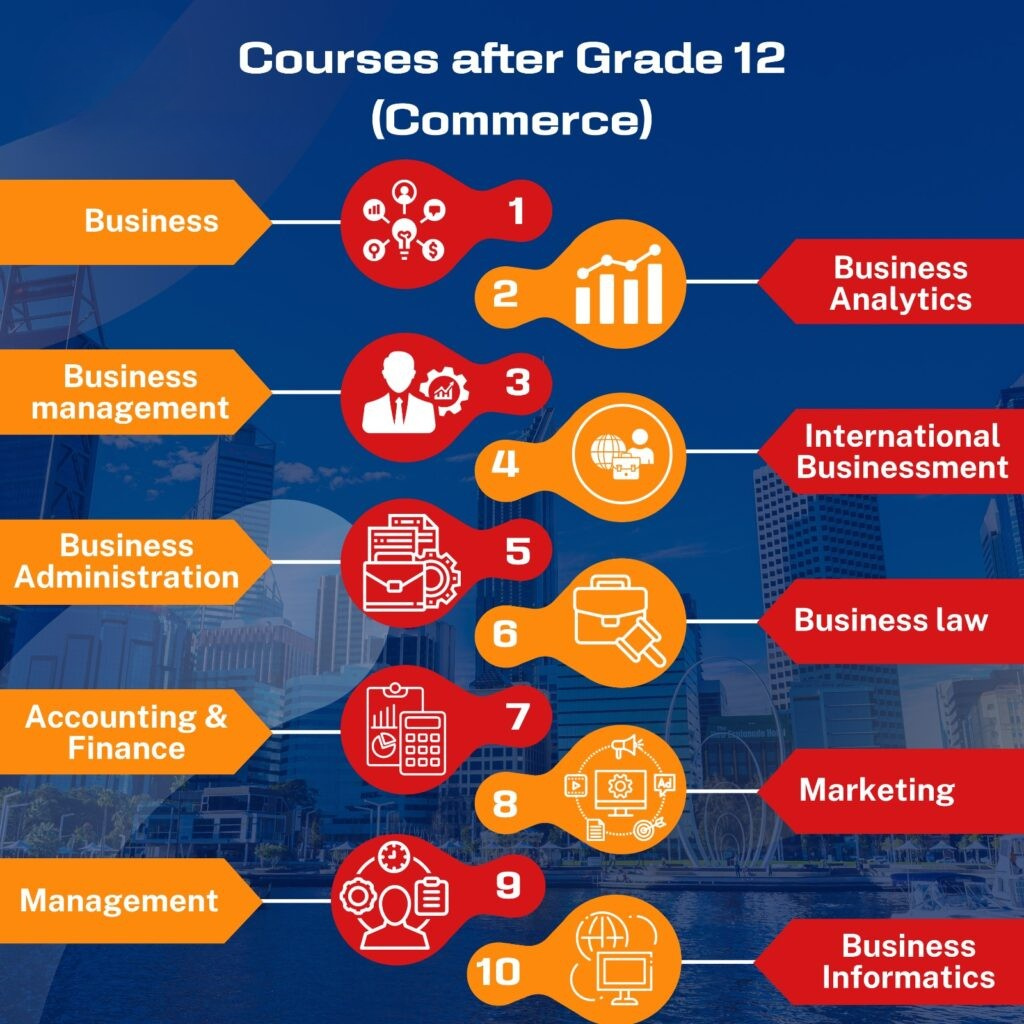
Courses after Grade 12 commerce in Australia

  1. Business
  2. Business management
  3. International Business
  4. Accounting and Finance
  5. Business Administration
  6. Business law
  7. Marketing
  8. Business Analytics
  9. Management
  10. Business Informatics
  • Business:

Students who want to study business has several options such as entrepreneurship, marketing, or finance. It provides full knowledge about business principles and prepares students for diverse roles.

  • Business Analytics:

It involves utilizing data analytics and techniques of how to extract the statistics data which help to take business decisions. Students will learn how to solve complex data and improve the performance.

  • Business Management:

It focuses on developing leadership qualities and managerial skills to make strategic decisions. They will learn how to plan, organize, and coordinate to achieve the business goals.

  • Business Informatics:

It helps to combine the business management and information technology tomaximize decision making abilities. Students will get professional knowledge about technology and data analysis to improve business performance.

  • International Business:

As its name suggests student will study about the international trade, diverse culture management & to make strategies. Students will solve the complexities and build career in international business, development and financial.

  • Business Administration:

Gives knowledge about management practices and principles. It focuses on the firm’s behavior, planning, marketing and prepare applicants for leadership skills.

  • Business Law:

It aims the legal areas such as organization transactions, corporate law & other aspects applicable to the business environment.

  • Finance & Accounting:

This program is the combination of the principles of accounting and financial management. Students can excel their skills in taxation, auditing which led to the investment analysis and accounting sectors.

  • Marketing courses in Australia:

The focus of the program is to understand the customer behavior, branding and make strategies to promote product/brand.

  • Management courses in Australia:

Management skill will help to make decisions for the organization and manage the resources. It focuses on the firm’s behaviour, human resource management and planning.

Top Universities for Commerce Courses in Australia:

UniversitiesCoursesEntry Requirements
Victoria UniversityBachelor of Business in Banking & Finance
Bachelor of Business in Financial Management
IELTS- 6.0(no band less than 6)
TOEFL – 67
Edith Cowan UniversityBachelor of Commerce
Bachelors of Marketing, advertising & public relations
IELTS – 6.0 (no modules less than 6)
TOEFL- 70
PTE – 57- 64
Curtin UniversityBachelor of Business Administration
Bachelors of Law
Bachelor of Commerce
IELTS – 6.5 (minimum 6 in each module) 
The University of SydneyBachelor of Commerce
Bachelors of Laws
IELTS – 7.0 (minimum of 6.5 in each module)
TOEFL- overall 96  (20 in Reading, writing) (22 in Speaking & Writing)
University of New South WalesBachelor of Laws
Bachelors of arts & Business
IELTS – 7 (minimum 6.5 in each section)
TOEFL – overall 94 (25 in writing) (23 in Reading, Speaking & Listening)
Royal Melbourne Institute of Technology (RMIT)Bachelor of Business in entrepreneurship
Bachelor of Applied economics & Finance
IELTS – minimum 6.5 band
TOEFL- minimum 79

 Eligibility Criteria to study courses in Australia after commerce:

The eligibility criteria may vary university to university. Here is the some of the general criteria:

  1. Applicants should have completed Grade 12 in commerce. Some institutes also mentioned pre-requisite subjects.
  2. International students must demonstrate English language test scores such as IELTS, TOEFL or PTE.
  3. Applicants also need to demonstrate education transcript from previous institutions.

Make sure to check all the eligibility criteria or documents once on the university/college official website.

 Jobs after commerce courses in Australia:

Australia offers variety of job options in several sectors. Here are some of them:

JobsRoles
AccountantPrepare financial statements.Give financial advice to firm.
Financial AnalystAnalyze financial data.Involves in decision-making.
Business AnalystEnhance profitability.Identify spot for improvement. 
Marketing ManagerThink marketing strategies.Do promotional campaigns about product/brand. 
Human Resource ManagerRecruit’s employees, evaluates performance. 
Financial PlannerCreates financial plans, investment strategies.
Investment AnalystAnalyze the investment opportunities.Give ideas on investment.

Still thinking about the popular courses to study in Australia after 12th commerce. Well, there are many courses to choose with specialization in particular field such as accounting, financing and more.                                       

Students can also choose dual degree programs. Australia has top-notch universities with diverse culture.  Want to know more about study abroad, get in touch with our expert’s counsellors at DK Visa Consultant

FAQ

Q1. Is Australia being good for studying for international students?

Ans:  Australia is known for its well-known for its universities/degrees with cross-culture and career prospective.

Q2. What is the general English test are required to apply for an Australian university?

Ans: Students need to demonstrate English test language score such as IELTS, TOEFL and PTE to apply for an Australian university.

Q3. What is the minimum CGPA for study-visa in Australia?

Ans: The minimum CGPA for study visa in Australia is 65, if students want to pursue an undergraduate course.

Q4. Can students work while studying in Australia?

Ans: Yes, international students can work part-time while studying. They are restricted to work 20-hours a week.

Q5. What type of jobs are offered in Australia after completing undergraduate course in Commerce?

Ans: Australia offers a variety of job options such as Accountant, Financial Manager, Human Resource Manager and more.