10 Reasons for UK Student Visa Rejection

The last thing applicant want to happen during their academic journey is to have UK student visa rejection, isn’t that, right? Did anyone still have their UK student visa rejection, nevertheless, even after making every effort and learning all the interview questions by heart? The UK student visa is essential to realizing applicant aspirations in the UK because it allows them to enroll in some of the most esteemed universities globally.

Read the blog to know about the main reason why individuals UK visa can rejected.

10 Factors for UK Student Visa Rejection:

Below is the reason for UK student Visa rejection:
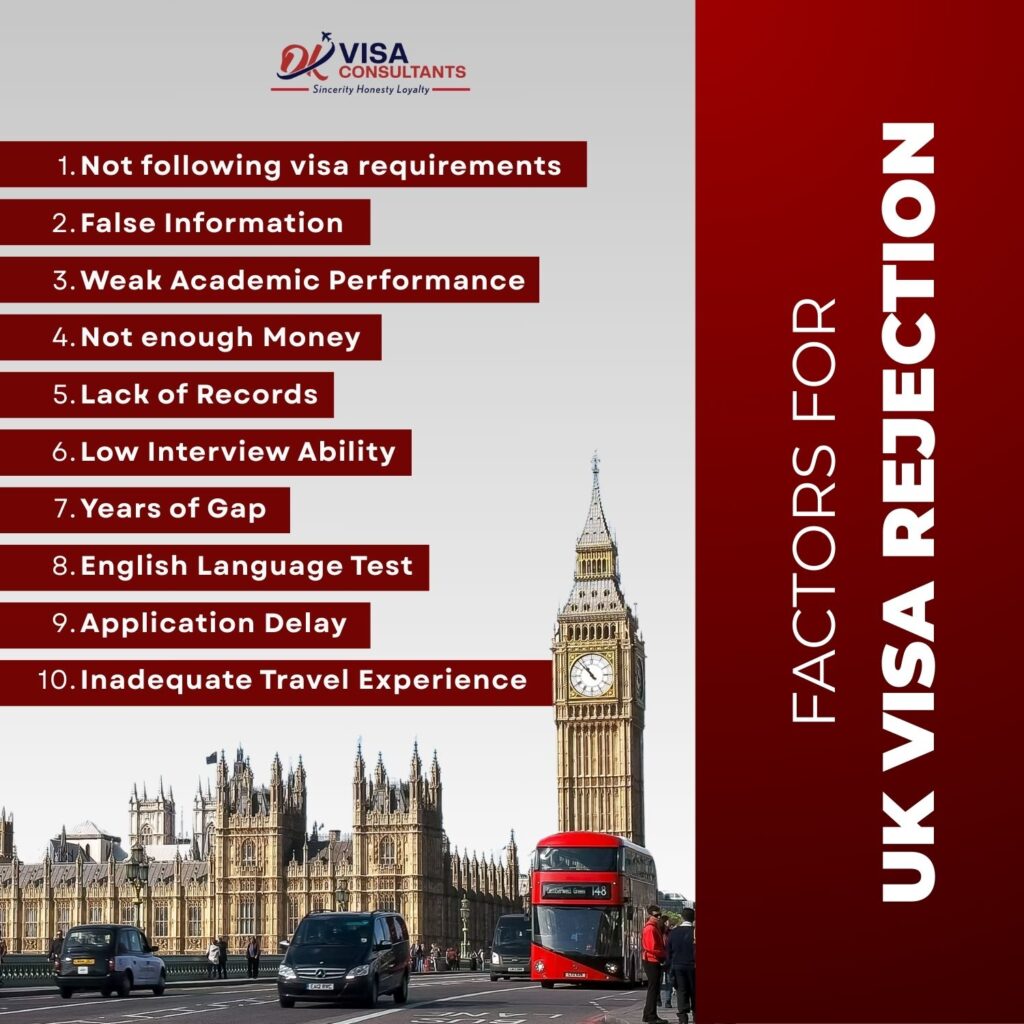
  1. Not Following Visa Requirements:

An essential element of UK security is immigration. The immigration authorities in the United Kingdom have devised multiple regulations and protocols. For the visa application process to be straightforward and efficient, compliance with laws and regulations is essential. Because the applicants don’t follow the regulations, most visa applications are denied or turned down.

  1. False Information:

The most common reason for a UK student visa rejection is providing false information on application. It is possible that applicant unintentionally provided inaccurate or out-of-date information which updated, such as address or name’s new initials.

Such information is taken into consideration when denying a visa. If any of the information on the application form differs from the information on their travel documents, application will denied. Verify that the data on the application form corresponds to the information in passport.

  1. Weak Academic Performance:

The prerequisite of providing a list of academic achievements is a significant concern for applicants to the UK’s top universities. Because of the strict requirements, many students are unable to meet the exceptional academic standards that the institutes maintain.

When students fail to achieve these requirements, their UK student visas were canceled. If the government that issued the visa thinks the student won’t be able to handle the country’s educational system or would experience linguistic barriers. Therefore, this could potentially be a factor in the denial of a UK student visa.

Also Read: The UK Travel Guide For International Students 

  1. Not Enough Money:

Rejecting an application for a UK student visa is frequently due to insufficient funds. If individual plan to study abroad, they must have a minimum balance that covers their living expenses and tuition for the whole academic year. The law further mandates that the funds in the bank account applicant plan to link the data to must be at least 28 days old.

  1. Lack of Records:

One more reason for the denial of a UK student visa is inadequate paperwork. Students frequently apply for visas, and they urged to provide any supporting documents. They may need to address immigration and student visa concerns in the UK as soon as possible. But given that a lot of records are now readily available online, applicants minimize the importance of this vital paperwork. Each document’s visibility and configurations must thoroughly checked.

  1. Low Interview Ability:

An extensive evaluation of a UK student visa grant is part of the student interview procedure. Many students face the risk of having their lack of preparation or hesitant responses count against them when applying for a UK student visa. To prevent any circumstances, they should prepared with all the necessary guidance for the student visa interview.

Typical questions an interviewer might ask are follows:

  1. Understanding of the country, state, and city.
  2. Details regarding the university they enrolled, study techniques.
  3. Examining the history.
  4. Essential information regarding studying overseas.‍
  1. Years of gaps:

Although taking a gap year can beneficial for mental well-being, keep in mind that it is frequently a cause for visa rejection! When handling gap years, applicant should always opt to provide an explanation for their actions to steer clear of such typical justifications for the denial of a UK student visa. 

But remember to give mental health top priority! This justification can also supported with appropriate justification, and one method to do so is to well-versed in all matters pertaining to gap years.

  1. English Language Test:

 To apply for a Tier 4 Student Visa, candidate must meet the language proficiency standards in English. These requirements, which are set by the school applicants are enrolled in, must met with an IELTS or TOEFL score. It’s usually helpful to grasp the basics of these references.

  1. Application Delay:

Processing timeframes differ for various organization tasks and depend on several factors. It recommended by the US embassy that applicant should submit their application as soon as possible following their intended departure date. It is possible that application will rejected if applicant submit it after the embassy’s stated deadline. Another explanation for the denial of a UK student visa is a delayed application.

  1. Inadequate Travel Experience:

Unsatisfactory travel history could harm candidates current visa applications. If applicant have a history of overstaying visas, have previously had visa for the country (or any other country) denied or participated in activities that are prohibited by a particular category of visa, etc., application may denied.

 Conclusion

Each year, thousands of Indian students come to study in the UK, which is one of the most sought-after studies abroad locations worldwide. Still, selecting the best university and course to take are challenging choices to make. With so many factors to consider, making final decisions can be extremely difficult.

For comprehensive answers, visit DK Visa Consultant. Meet our experts and indulge in end-to-end conversation about study abroad.

FAQ

Q1. What are the typical causes for a student visa rejection?

Ans: Typical causes for student visa rejection include not having enough money, not having the necessary paperwork, giving inconsistent information, and not being proficient enough in English.

Q2. What distinguishes a visa rejection from a refusal?

Ans: Refusing your visa usually indicates that there is something lacking from your application, which you can fix and submit again. A denied visa application typically means that there are problems with the application that are difficult to fix or that it does not match the requirements.

Q3. How will the denial of UK student visa impact my next application for a visa?

Ans: Rejections can have an impact on subsequent visa applications, particularly if the grounds for the denial are not addressed. Before reapplying, it is imperative to address the problems and make sure all requirements are satisfied.

Q4. How can I increase the probability that my visa application will be approved?

Ans: Boost your chances by making sure all the information is correct, fulfilling all the financial requirements, supplying all the relevant paperwork, and getting ready for any mandatory interviews.

10 Best Countries To Study Abroad 2025

Unexpectedly, 100,000 overseas students took the skies in 2024 to pursue higher studies in the USA (United States of America). Although the appeal of USA is undeniable but other countries are also having an impact on the global education. The UK located on the other side of the Atlantic, has a varied cultural background and a captivating history of its own.

The capital of the United Kingdom, London has a distinguished history as a major financial hub for centuries. Whether the British legacy or the American ideal appeals, these nations have fascinating histories that entice travelers and academics alike. In addition to the USA and the UK, there are numerous other nations that are eager to receive the application.

Read the blog to know about the best 10 countries to study abroad in 2025 including costs, scholarships, funding and more.

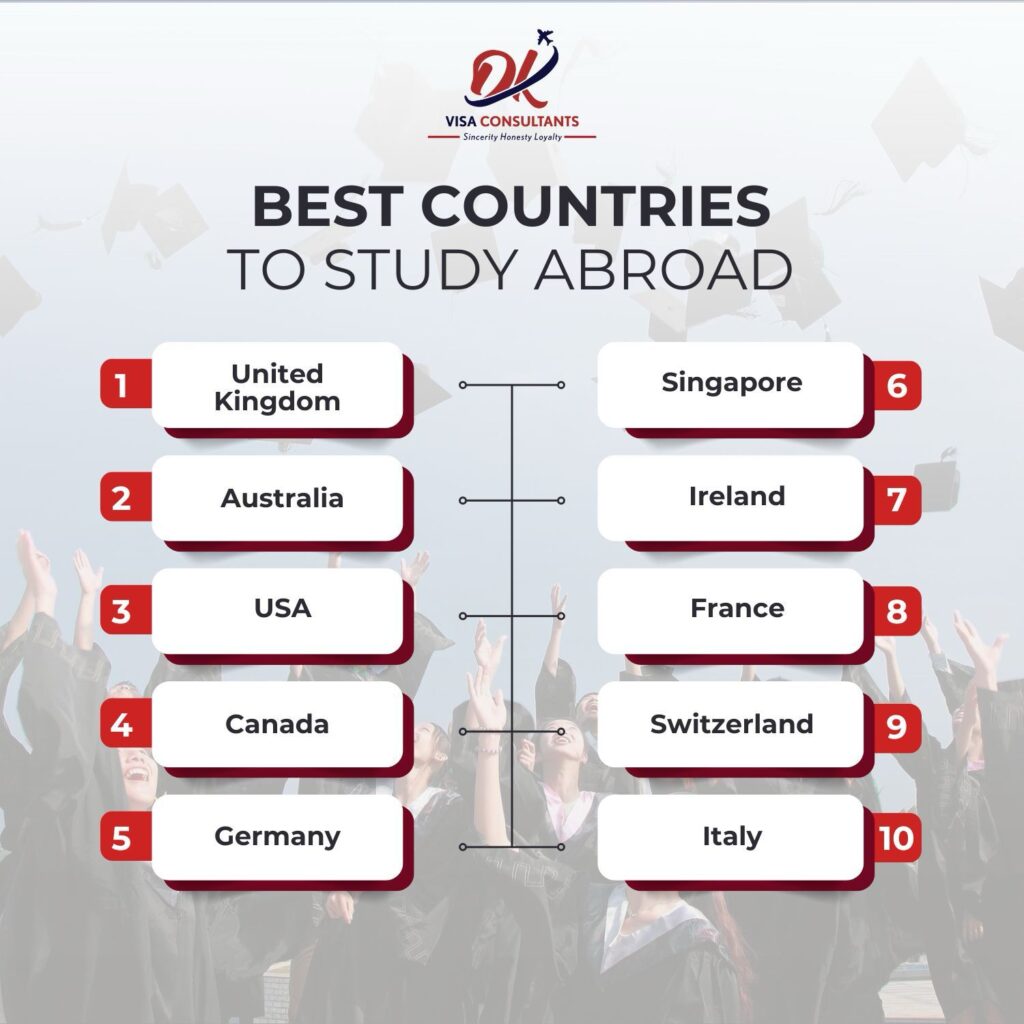
 Best Countries to Study abroad:

Check out the list of countries:

10 Best countries to Study Abroad
  1. United Kingdom (UK):

The UK is home to prestigious academic establishments such as Imperial College London and University of Cambridge. A degree from a UK university offers beneficial connections in the industry and practical experience. The term of stay in the UK is valid for a period of 12 to 24 months.

CoursesEstimated Fees* (GBP)
Master’s in Business AnalyticsGBP 25,750 to 35,000
Data science23,000 to 25,000 GBP
MBAGBP 31,000 to 87,000
  1. Australia:

Australia’s academic prowess, international reputation, dynamic cities, multicultural society, stable economy, and stunning natural landscapes make it an appealing choice for overseas students. It’s a favored option because of prestigious universities like UNSW Sydney and the University of Melbourne.The length of stay in Australia might range from 18 to 24 months.

CoursesEstimated Fees* (GBP)
NursingGBP 20,000 to 35,000
Postgraduate in Cybersecurity15,000 to 50,000 GBP
Computer Science EngineeringGBP 15,000 to 50,000
  1. USA:

The USA is renowned for its Ivy League universities and wide range of academic programs, and it offers opportunities for both professional and personal growth. Top universities on the list are MIT and Harvard. For non-STEM studies, the stay-back period in the US is 12 months; for STEM courses, it is 24 months.

CoursesEstimated Fees* (GBP)
Master’s in business AnalyticsGBP 39,000 to 90,586
Data Science21,000 to 75,000 GBP
MBAGBP 30,000 to 1,20,000
  1. Canada:

Academic brilliance at Canadian universities is well-known throughout the world. Two excellent options are McGill University and the University of Toronto. In Canada, the length of the stay-back depends on the length of the course; if the course lasts two years or more, the stay-back is three years.

CoursesEstimated Fees* (CAD)
Business ManagementCAD 19,000 to 56,000
Media & Journalism14,000 to 70,000 CAD
IT & Computer ScienceCAD 18,000 to 28,000
  1. Germany:

Germany is among the greatest and most economical countries to study because it offers free tuition. The Technical University of Munich and Ludwig-Maximilians-Universität München are ranked highest. The period of stay in Germany is valid for eighteen months.

CoursesEstimated Fees* (EUR)
NursingEUR 300 – 800
Management10,400 to 49,500 EUR
Computer ScienceEUR 3,000 for public collegesEUR 10,000-40,000 IN private colleges
  1. Singapore:

Renowned Asian destination Singapore, home to colleges such as NUS and NTU Singapore, provides internationally recognized programs. The duration of stay-back in Singapore is between one and three months.

CoursesEstimated Fees* (SGD)
BusinessSGD 20,650
Dentistry66,650 SGD
ComputingSGD 17,650
  1. Ireland:

With prestigious universities like Trinity College Dublin and University College Dublin, Ireland offers a wide range of academic options. The period that can be spent in Ireland is 24 months.

CoursesEstimated Fees* (EUR)
BA in HumanitiesEUR 13,000 to 20,000
Law programs15,000 to 28,000 EUR
Philosophy,Politics DegreeEUR 15,000 to 28,000
  1. France:

France, known for its thriving culture and prestigious universities, offers an excellent, affordable, and enriching education. Université PSL and Institut Polytechnique de Paris are two of the top academic institutions that prioritize cutting edge research and transdisciplinary excellence. France is known as a global center for business education in part because it is home to internationally acclaimed business schools like INSEAD and HEC Paris, which are both well-known for their MBA and executive education programs. The period that can be spent back in France is 12 months.

CoursesEstimated Fees* (EUR)
BA in HumanitiesEUR 13,000 to 20,000
Law programs15,000 to 28,000 EUR
Philosophy,Politics DegreeEUR 15,000 to 28,000
  1. Switzerland:

Switzerland is renowned for its diverse population and stunning natural surroundings. It is home to prestigious universities like EPFL and ETH Zurich. The period of stay in Switzerland is good for six months.

CoursesEstimated Fees* (EUR)
Management10,400 to 49,500 EUR
 Computer ScienceEUR 3,000 for public collegesEUR 10,000-40,000 IN private colleges
EngineeringEUR 300 – 800
  1. Italy:

Italy provides excellent education as well as an incredible experience. Politecnico di Milano and Sapienza University of Rome are two highly regarded universities. The duration of the stay to Italy is one full year.

CoursesEstimated Fees* (EUR)
Arts & Architecture800 to 3,500 EUR
Cultural StudiesUndergraduate studies 900 to 4,000 EURO
Fashion /Interior DesigningEUR 8,800 to 17,200 EUR

Want to find, which is the best country to study abroad? Visit DK Visa Consultant, our experts will help to find the suitable country to study.

FAQ

Q1. Which countries are best to study masters courses?

Ans: Indian students frequently choose to study in nations like Germany, Australia, Canada, and the United Kingdom. These nations provide excellent master’s degree programs, a wide range of educational options, and welcoming communities.

Q2. Which country is best after Grade 10 for Indian Students?

Ans: After completing their Grarde 10 or 12, many students choose to study in UK. The nation provides a wealth of educational options as well as a varied cultured experience.

Q3. Which top universities are in the finest nations for international study?

Ans: The best colleges differ by countries and provide a wide range of academic excellence and programs.

  1. University of Oxford and University of Cambridge, United Kingdom.
  2. Universities of Sydney and Melbourne are located in Australia.
  3. McGill University; University of Toronto are in Canada
  4.  Munich Technical University and Bonn University are in Germany.

Facts To know before Studying Australia as Student

Before relocating to Australia to continue education, there are a lot of things applicant should be aware of. Understanding the fundamentals of the nation student intend to relocate to will help them to make the best choice and adjust their plans.

With a population of only 26,655,620, Australia is almost 2.4 times larger than India. Australia is one of the most sought-after studying abroad locations because of its top-notch educational system, breathtaking scenery, energetic cities, and oceans. With more than 22,000 courses to choose from, Australia has one of the greatest higher education systems in the world. Australia is home to 42 universities, 37 of which are public and the rest private.

Read the blog to know about the Australian facts before studying as a student.

Facts about Australia Studying

In addition to focusing on academic success, trip to Australia will be a cultural adventure unlike any other. Australia draws students from all over the world with its internationally renowned universities, breathtaking scenery, and energetic cities. There are several things individual should know about Australia before embarking their transformative journey. A diverse population creates a dynamic and welcoming learning environment by exposing pupils to a melting pot of cultures. 

Furthermore, Australia’s educational system places a strong emphasis on hands-on learning, equipping graduates to handle obstacles in the real world. A seamless transition into the Australian academic environment is ensured by being aware of these subtleties, which range from visa procedures to unusual wildlife encounters.

  • Third most popular study destination worldwide

After the US and the UK, Australia is the third most popular country in the world for students to study. Students from more than 180 countries come here. For students from nations like China, India, Korea, Thailand, and Vietnam, it is one of the most popular studying abroad options. 

According to a survey, Australia will rank second on the list of most popular study abroad locations and draw more students than the UK in the future. It is the third most popular country for studying abroad in 2024 because of its varied educational options, less cost of living compared to the UK and the USA, and excellent quality of life.

  • Best Institutes to Study

Some of the best universities in the world are located in Australia. Nine Australian universities are in the top 100 in the world. These are

  1. The University of Melbourne
  2. University of New South Wales
  3. University of Sydney
  4. Australian National University
  5. Monash University
  6. University of Queensland
  7. University of Western Australia
  8. University of Adelaide
  9. University of Technology Sydney
  • International student scholarships

International students can reduce the cost of their studies in Australia by applying for one of the many scholarships that Australia offers. These scholarships allow students who excel academically and extracurricular to attend Australia’s best universities. In order to provide international students more flexibility in continuing their education during the pandemic, the government also provides online learning opportunities.

  • Visas for Students

Applicant must have a student visa subclass 500 if they intend to study in Australia for an extended length of time. Applying for a student visa to study in Australia is a simple procedure. Student can apply for a student visa totally online; they don’t even need to go to the embassy. Candidate must pay the 650 AUD visa cost when they apply for a student visa. They should be allowed to enter Australia on an ordinary visitor visa, though, if they intended stay is shorter than three months.

  • Opportunities for Employment

Candidate will have the opportunity to work while they are studying in Australia. An international student is permitted to work up to 20 hours per week under the terms of the Australian Student Visa. Students have a time limit on how many hours they can work during class, but they are free to work as much as they like during breaks. If they can manage employment and education in Australia, it’s worth it, especially with the high minimum salary (AUD 21.38 per hour)! It will look good on their resume and is a terrific opportunity to meet people in new city.

  • Living Expenses 

It is true that living and studying expenses in Australia are significantly lower than those in the US and the UK. However, the studies are heavily influenced by choice of study or residence in Australia. Australia makes it easier for students to live and finance their education by allowing them to work part-time while they are enrolled in classes.

  • Greatest System of Higher Education

With its extensive curriculum, high standards, and highly educated teachers, Australia boasts one of the top higher education systems in the world for both domestic and international students. According to the Universities 2019 U21 Ranking of National Higher Education Systems, Australia’s educational system is placed eighth in the world, ahead of nations like France, Norway, Germany, and Japan.

  • Different System of Grading

Candidate should be aware that Australia’s grading system differs from India’s before relocating there to pursue higher education. Understanding how the Australian grading system operates is crucial. As students are aware, a D grade is an indication of failure and is not seen as exceptional in India. “D” is an outstanding grade in Australia, nonetheless. Let’s examine the grade list so that candidate can gain a better understanding.

  1. High Distinction, or HD
  2. D: Distinction
  3. C: Acknowledgement 
  4. P: Pass 
  5. F: Failing
  • Difficult Time Difference

America and Australia are separated by a considerable amount of time. It is beneficial for student to settle in as soon as they arrive in Australia.

Finding the precise moment to connect with friends and family back home will be a challenge until they have recovered from the jet lag phase. There are three time zones in Australia, and five during DST. Australia and India are separated by 4 hours and 30 minutes.

  • Weather Varies Across Regions

Australia’s climate ranges from tropical in the north to temperate in the south. For example, Melbourne weather can change rapidly, while Brisbane offers warm, humid conditions year-round.

Conclusion:

Selecting Australia as study abroad destination will be a wise decision. After the United Kingdom and the United States, Australia is a popular destination for international students. It also boasts a stellar reputation for academic brilliance and is home to some of the top universities in the world.

Students are now aware of the factors to take into account before making a final selection. Are you thinking of any more questions? Do not be concerned! Our knowledgeable and skilled counsellors are available to assist you with any questions you may have. Speak with DK Visa Consultants advisors right now.

FAQ

Q1. What Is Australia’s International Student Acceptance Rate?

Ans: The majority of Australian universities have an acceptance rate that ranges from 65% to 80%. The admittance percentage at more competitive universities, like the University of Sydney, is about 30%. You probably won’t have any problems as long as you fulfil the program’s prerequisites.

Q2. Is Australia Home to a lot of International Students?

Ans: Australia has a large number of international students. A record 700,000 international students studied in Australia during 2023 and 2024. This fosters a multicultural and varied student body, particularly in places like Sydney, Melbourne, Brisbane, and Perth.

Q3. What is the most well-known thing about Australia?

Ans: Australia is well-known around the world for its beaches, deserts, “The Bush,” “The Outback,” and wide-open landscapes.

Q4. What is the Australian study checklist?

Ans: Remember to bring these items with you:

  • A passport that is currently valid 
  • Entry permission and student visa
  • A copy of your electronic enrolment confirmation (COE)
  • Evidence of payment
  • Your scholarship award letter (if applicable)
  • Plug adapters for electrical devices
  • A dictionary that is bilingual.

Q5. What are some of Australia’s fascinating facts?

Ans: Below are the facts:

  • Due to the ongoing dispute between Sydney and Melbourne over the choice of capital, Canberra was chosen.
  • In 1902, Australia became the second nation in the world to grant women the right to vote.
  • Compared to Switzerland, the Australian Alps receive more snowfall.
  • The world cockroach racing championships are held in Brisbane every year.

10 Cheapest colleges for MBA in Australia

Australia is very famous all over the world for its higher education system. It is marked as the fourth country in the entire world, where students prefer to go for studying away from their country. Australian five institutions fall under the world top 50 universities according to the QS World Ranking 2024. For international students, it is a popular place to study MBA in Australia.

Human resources and marketing are the main subjects at Australian Business Schools. This option can provide candidates a step towards building a fruitful career in the business sector. Australia has also known it as an open door to professional opportunities. It is home to a number of top-ranked B-schools. And yet, it’s still not that much costly as compared to other forms of education.

Read the blog to know about the best cheapest colleges for MBA in Australia.

Reasons for pursuing an MBA in Australia:

Some of the finest universities in the world are in Australia. This year, approximately 20,000 international students on the MBA in Australia will be welcomed by universities. Some of the main considerations that influence the decision of international students to study MBA in Australia are given below:

  1. Australia considered one of the three most liveable countries in the world. Because of good education system maintaining a high standard of living. 

2. Due to its high educational program reputation, graduates from Australia tend to be in high demand.

3. The Australian government through the ESOS Act and national regulatory bodies such as TEQSA provides protection for overseas students in Australia.

4. The AQF sets the framework for recognition of qualifications in countries all over the world with similar credentials being provided for use locally.

Cheapest colleges for MBA in Australia:

Below are the best MBA Colleges offering affordable tuition for MBA in Australia for Indian students:

Universities /Colleges
Kaplan Business School
Holmes Institute
Charles Darwin University
Victoria University
Edith Cowan University
Central Queensland University
James Cook University
University of Southern Queensland
Federation University
University of Sunshine Coast

Top MBA Courses & Tuition Fees

Here is the list of best courses:

CoursesDuration (Year)Estimated Fees (Yearly)*University
Project Management, Digital Management2 ₹8,43,320Kaplan Business School
Accounting, Business Administration1.5₹8,43,320Holmes Institute
MBA in Sustainable Enterprise12 months₹11,27,720Charles Darwin University
General MBA2₹11,48,560Victoria University
MBA1.5₹11,71,320Central Queensland University
Master of Business Administration2₹17,95,370Edith Cowan University
MBA1.5₹25,47,640University of Southern Queensland
Master of Business Administration2₹18,93,400James Cook University
MBA1.5₹15,05,620University of the Sunshine Coast
Master of Business Administration2₹16,60,510Federation University

Cost of Studying MBA in Australia

In Australia, the average cost of attending school is approximately AUD 59,966 (INR 32,89,150). The annual tuition for Australia’s affordable MBA schools ranges from AUD 45,000 (INR 24,68,260) to AUD 822,000 (INR 4,50,86,930).

When figuring out how much it will cost to study in Australia, also need to consider the cost of living there for international students. The average annual cost of living is AUD 20,000 (INR 10,97,000).

Note: Tuition fees depend on the university and courses applicant wish to pursue

Scholarships for MBA Students in Australia

Here are some notable scholarships available in 2025:

ScholarshipEligibilityBenefits
Dean’s International Management ScholarshipFull-time MBA students at Melbourne Business SchoolFull tuition waiver
Clemenger BBDO ScholarshipMBA Marketing students (merit-basedUp to AUD 50,000 (INR 27,07,950)
Women in MBA ScholarshipFemale MBA candidates50% tuition fee covered
Diversity Excellence ScholarshipFull-time MBA at Melbourne Business School50% program fees

Job Prospects after MBA in Australia

Graduates with an MBA from an Australian university have access to post-study work visas and can pursue high-paying careers.

Job TitleEstimated Annual Salary (AUD/INR)*
Business Development ManagerAUD 100,000 / ₹54,15,890
Operations ManagerAUD 82,000–120,240 / ₹44,41,030–₹65,08,780
Business AnalystAUD 95,000–100,000 / ₹51,45,100–₹54,15,890
Account ManagerAUD 95,600–126,710 / ₹51,77,590–₹68,62,480
Marketing CoordinatorAUD 65,000 / ₹35,20,330

Visa Update (2025): Students graduating with eligible master’s degrees in regional areas may get up to 6 years of post-study stay, enhancing job and PR prospects.

Studying an MBA in Australia remains a smart choice in 2025. Whether you’re looking for affordability, academic prestige, or post-study career opportunities, Australia provides a well-rounded experience for international students.

Planning to study in Australia, visit DK Visa Consultant and talk with our experts team for proper guidance.

FAQ

Q1. Is it worth doing a low-cost MBA in Australia?
Ans: Yes. Many affordable MBA programs in Australia are offered by reputable universities featured in global rankings and recognized worldwide.

Q2. How much does an MBA in Australia cost for Indian students?
Ans: On average, MBA programs cost between AUD 20,000 and 45,000 annually, depending on the university and course.

Q3. How long does it take to complete an MBA in Australia?
Ans: MBA durations vary between 1 to 2 years, with some intensive programs completed in 12–15 months.

Q4. What are the popular MBA specializations in Australia?
Ans: Top specializations include:

  • Marketing
  • Finance
  • Healthcare Management
  • Human Resource Management
  • Entrepreneurship

Q5. Can I stay in Australia after completing my MBA?
Ans: Yes. International students are eligible for Post-Study Work Visas of 2 to 6 years, depending on course and location.

The UK Travel Guide for International Students 

The United Kingdom is not only a world-renowned destination for academic excellence but also a treasure trove of travel opportunities. From historical landmarks and cultural festivals to breath-taking countryside and modern cities, the UK offers an immersive experience beyond lecture halls and libraries. For international students, exploring the UK provides valuable exposure to regional cultures, historical contexts, and natural beauty—all while remaining cost-effective and accessible. 

This comprehensive travel guide outlines the best destinations, tips for getting around, and practical advice tailored for international students studying in the UK.

UK Travel Guide for students

Check out the travel guide for the International students:

1. Must-Visit Destinations Across the UK

  • London

As the political, cultural, and financial capital, London offers iconic attractions such as the British Museum, Big Ben, Buckingham Palace, and the West End theatre district. Beyond its landmarks, London’s neighbourhoods—like Shoreditch, Notting Hill, and Camden—offer diverse culinary scenes and artistic flair.

  • Edinburgh

The Scottish capital combines gothic architecture with rich history. Edinburgh Castle, Arthur’s Seat, and the Royal Mile are key highlights. In August, the city comes alive with the famous Edinburgh Festival Fringe—the world’s largest arts festival.

  • Manchester 

A hub for music, sports, and industry, Manchester is home to two major football clubs, vibrant nightlife, and museums such as the Science and Industry Museum and the Manchester Art Gallery. It’s also a gateway to the Peak District National Park.

  • Oxford & Cambridge

Known for their historic universities, both cities are steeped in tradition and beauty. Punting along the River Cam or visiting the Bodleian Library offers a glimpse into centuries of academic heritage.

  • Bath  

A UNESCO World Heritage site known for its Roman baths and Georgian architecture. Bath also provides a tranquil escape with scenic parks and historic tea rooms.

  • Lake District & Scottish Highlands

Nature lovers can explore the UK’s most stunning landscapes, from the lakes and valleys of Cumbria to the dramatic lochs and mountains of Scotland. Ideal for hiking, cycling, and weekend retreats.

2. Transportation: Getting Around the UK

  • Rail Travel

The National Rail network connects all major cities and towns. Booking in advance through sites like Trainline or National Rail can yield significant discounts. For frequent travellers, a 16–25 Railcard (also available to full-time students over 26) offers 1/3 off most fares.

  • Coach Services

Companies like National Express and Megabus provide low-cost intercity travel. Although slower than trains, these are budget-friendly options for long-distance travel.

Local Transport

  • London: The Oyster Card or contactless payment provides access to the Tube, buses, trams, and rail services.
  • Other Cities: Most offer student bus passes and integrated transport systems.

Domestic Flights

Useful for reaching remote areas such as Northern Ireland or the Scottish islands. Budget airlines such as EasyJet and Ryanair offer competitive prices for early bookings.

3. Budget Travel Tips for Students

  • Accommodation: Hostels (e.g., YHA, Hostel world) and university student accommodations (during holidays) offer affordable stays.
  • Student Discounts: Use a TOTUM or ISIC card for discounts on travel, entertainment, and dining.
  • Free Attractions: Many UK museums and galleries, such as the National Gallery in London or Kelvingrove Art Gallery in Glasgow, offer free admission.
  • Food: Supermarkets offer meal deals and budget-friendly groceries. Markets and local eateries also provide cost-effective dining options.

4. Travel Etiquette and Safety

  • Respect Local Customs: Queueing is a social norm. Politeness and punctuality are appreciated.
  • Weather Preparedness: The UK is known for sudden weather changes. Carrying an umbrella and wearing layered clothing is advisable.
  • Travel Insurance: International students should secure travel insurance covering medical emergencies, especially when exploring rural or remote areas.

5. Weekend Getaways and Day Trips

  • Brighton: A seaside town known for its pier, vibrant arts scene, and pebble beach.
  • Stratford-upon-Avon: Shakespeare’s birthplace with well-preserved Tudor architecture.
  • York: A historic city with medieval walls, a grand cathedral, and Viking heritage.
  • Windsor: Home to Windsor Castle and quaint riverside walks.

Conclusion

Exploring the UK is an enriching complement to academic life, offering international students a deeper understanding of British culture, history, and diversity. Whether it’s hiking in the Highlands, attending a West End play, or discovering hidden gems in local markets, the UK provides endless opportunities for discovery. With smart planning, discounted travel, and a sense of curiosity, every weekend can become a new adventure.

For personalized assistance in planning studies or travel in the UK, DK Visa Consultant offers expert visa and education guidance tailored to international student needs.

FAQ

Q1: Is it safe for international students to travel around the UK alone? 

Yes. The UK is generally safe for travellers. Students should follow standard safety precautions, avoid poorly lit areas at night, and inform friends or flatmates when traveling solo.

Q2: Are there travel discounts for students in the UK?

Ans: Yes. Students can apply for a 16–25 Railcard, coach passes, and use student discount cards like TOTUM and ISIC for savings on travel and entertainment.

Q3: What is the best way to travel on a student budget? 

Ans: Coaches are the most budget-friendly for long-distance travel. Booking trains early, traveling off-peak, and staying in hostels also help reduce expenses.

Q4: Can students travel to Europe while studying in the UK?  

Ans: Yes, but a separate Schengen visa is required for most European countries. Short trips during holidays are common and encouraged for cultural enrichment.

Q5: What are some hidden travel gems in the UK?

Ans: Some lesser-known yet beautiful destinations include the Cotswolds, Snowdonia National Park in Wales, Isle of Skye in Scotland, and St Ives in Cornwall.